How many pallets of sod for a lawn
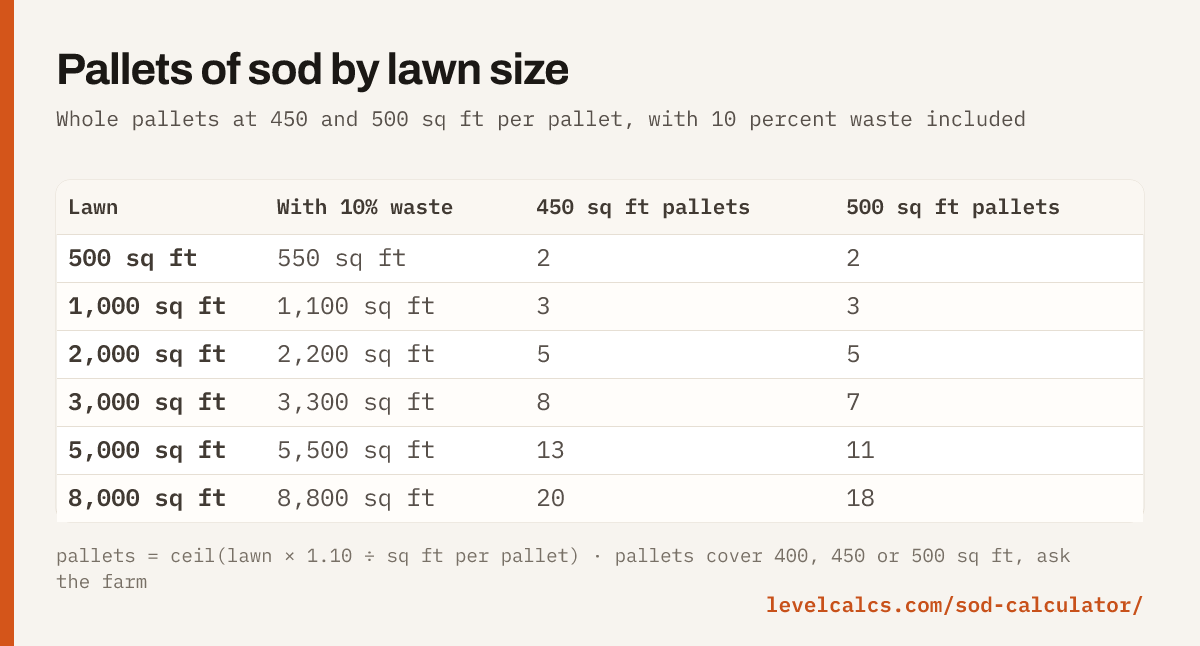
Counts include 10 percent waste and round up to whole pallets, because farms sell whole pallets. 8,000 sq ft is about the turf on a quarter-acre lot. Ask the farm whether its pallet is 400, 450 or 500 sq ft before you divide.
| Lawn | With 10% waste | 450 sq ft pallets | 500 sq ft pallets |
|---|---|---|---|
| 500 sq ft | 550 sq ft | 2 | 2 |
| 1,000 sq ft | 1,100 sq ft | 3 | 3 |
| 2,000 sq ft | 2,200 sq ft | 5 | 5 |
| 3,000 sq ft | 3,300 sq ft | 8 | 7 |
| 5,000 sq ft | 5,500 sq ft | 13 | 11 |
| 8,000 sq ft | 8,800 sq ft | 20 | 18 |
How much sod do I need?
Measure each lawn section, add them up, then add waste. Figure 5% for simple rectangles, 10% for curves and 15–20% for layouts with trees and beds. A standard roll covers 10 sq ft (2 × 5 ft).
A pallet covers 450 sq ft at most farms, but don’t assume it. The common band is 400–500 sq ft, and northern and Canadian farms often cut 600–700 sq ft pallets. Confirm before you divide by it.
Measuring a lawn that isn’t a rectangle
Almost no lawn is a clean rectangle, and the fix is to stop pretending it is. Break the area into shapes you can measure (rectangles, triangles and part-circles), work each one out and add the results. A rectangle is length times width, a triangle is half the base times the perpendicular height, and a circle is 3.14 times the radius squared.
Sketch the yard on paper first and number each shape. Then walk it with a tape or a measuring wheel and write the figures straight onto the sketch. To feed the total into the calculator, enter it as a one-sided figure (1 ft by 860 ft for 860 square feet) and let the waste slider do the rest.
Measuring the wrong thing is what costs real money. People measure the boundary off a deed, or pace out the whole backyard and forget the house footprint, the driveway, the shed pad, the beds and the walkways. Then they order a fifth more sod than they can physically lay before it spoils. Measure only what ends up green.
The opposite error is holding the tape level across a slope. That gives you the horizontal distance, while the sod has to cover the longer sloping face. A gentle 4:1 slope adds about three percent to the true surface area, and a steep 2:1 slope adds nearly twelve. On anything steeper than 4:1, run the tape along the ground.
Round up once, at the end, and round up to whole pallets, because whole pallets are what farms load. If your measured area plus waste comes to 1,050 square feet and the farm cuts 450 square foot pallets, you’re buying three pallets and 1,350 square feet. That’s 300 spare.
Knowing that before the truck shows up lets you plan somewhere useful for the extra, such as a strip beside the shed or a thin patch elsewhere in the yard, rather than improvising while the pallet cooks on the driveway. Will the farm split a pallet? Some will if you pick it up yourself, very few on a delivery.
Fence calculator, if the lawn’s getting a fence along the edge
Choosing the grass, not just the square footage
Sod comes in two families and they aren’t interchangeable. Warm-season turf (Bermuda, zoysia, St Augustine, centipede) is grown across the southern states and is usually cut as slabs, commonly 16 by 24 inches, or as wide machine rolls. Cool-season turf (Kentucky bluegrass, tall fescue and ryegrass blends) dominates the north and normally arrives as 2 by 5 foot hand rolls covering 10 square feet each.
Through the transition zone across Tennessee, Kansas and Virginia, both families suffer in one season or the other, and the local farm’s recommendation beats any national chart. Ask which form your order will be cut in before you plan the labor. Slabs and rolls handle very differently.
Sunlight decides the variety more than anything else does. Common Bermuda thins badly below roughly six to eight hours of direct sun, which is why it fails first under a maturing tree. Zoysia and St Augustine cope better, generally wanting four to six hours, and shade-selected cultivars of both are sold down to three or four.
Tall fescue is the cool-season equivalent. It’ll carry a shaded northern lawn at three to four hours where bluegrass simply won’t. Below about three hours of real direct sun no turfgrass holds long term, and sod laid there is money spent on a plant that dies within a season. Count the hours in midsummer with the leaves out, not in March when the canopy is bare.
Timing follows the same split. Cool-season sod goes down best in early fall or early spring with soil temperatures around 50 to 65°F. Warm-season sod wants late spring into early summer with soil above 65°F. Soil temperature is a far more reliable trigger than the calendar, and a cheap probe thermometer settles the argument in a minute.
Laying warm-season sod into cooling fall soil is the classic waste. It goes dormant before it has rooted and then lifts in the first hard frost. Early fall is probably the best single window across most of the country, since the soil is still warm, the air has cooled, and the rain does part of the watering for you.
Ground prep, delivery and the clock you’re working against
Finish the ground before the sod is ordered, not on the morning it arrives. Kill or strip the existing grass, till four to six inches deep to break the compaction, and work in two to three inches of compost. Then grade, and grade low.
Sod with its soil layer is about an inch thick, so the prepared surface needs to finish roughly an inch below every hard edge (patio, driveway, walkway, sprinkler heads). Skip that and you’ve got a permanent lip that the mower scalps every pass.
Rake a phosphorus-rich starter fertilizer into the top inch or two. Several states and Canadian provinces restrict phosphorus lawn fertilizer, with new sod the usual exemption, so check your local rules or ask the supplier. Firm the surface with a light roller, and damp it down so the sod lands on moist soil rather than dust.
Then the clock starts. Sod is a harvested crop with its roots cut off, and stacked on a pallet it heats from the inside out. Above about 80°F it starts declining within six to twelve hours and is often past saving at twenty-four. The middle of the stack cooks before the top layer even looks wilted. In cool spring or fall weather you’ve got a more realistic twenty-four to forty-eight hours.
Book delivery for the morning you intend to lay, and line up help. A pallet runs 1,500 to 3,000 pounds. A single 2 by 5 roll weighs 35 to 45 pounds off a normal harvest and can top 50 once it’s taken rain.
Lay from the longest straight edge you have, butt the joints tight without stretching the pieces, and stagger the end joints by at least twelve inches so no seam runs unbroken across the lawn. On a slope, run the strips across the grade rather than down it. On anything 3:1 or steeper, pin them with 6 in sod staples (steel or biodegradable) at each corner, one in the middle, and one every foot along the top edge.
Water heavily enough on the first day to wet the soil four to six inches down, not just the turf mat. Keep watering daily for the first two weeks and stay off it. Hold off the first mowing until the grass reaches three to four inches.
How Many Pallets of Sod for 1000 Square Feet
Three, at the common 450 sq ft pallet. Dividing 1,000 by 450 gives 2.2, and farms sell whole pallets, so the fraction rounds up to a full one.
Add the usual 5 to 10 percent for cuts and curves and you’re ordering for 1,050 to 1,100 sq ft, still three pallets, with roughly 250 sq ft left over.
Pallet size decides whether that spare is 250 sq ft or nothing at all. At 500 sq ft per pallet, two pallets is exactly 1,000, with no allowance whatsoever, and that is a poor bet on anything but a dead-square lawn. Buy the third, or ask whether the farm will add a partial. At 400 sq ft you’re buying three for 1,200.
Confirm the number before ordering, because pallet coverage moves your count more than any care you take with the tape does.
Three pallets is also 4,500 to 9,000 lb landing at once, which means a delivery with a forklift or a truck-mounted Moffett piggyback, not two runs in a half-ton pickup.
How Much Does a Pallet of Sod Cover
Most cover 450 sq ft, but the honest range is 400 to 500, and some farms cut pallets up to 700, a swing of more than 50 percent on the same word. Get the figure from the farm you’re buying from before you divide your lawn area by it.
The variation is a harvesting decision rather than a standard. Pallet weight (1,500 to 3,000 lb) is often the real limit rather than square footage, because the stack has to be liftable by whatever machine loads and unloads it.
Piece size drives it too. Southern slabs run 16 by 24 in and cover 2.66 sq ft each. Northern mini hand rolls are 40 by 18 in for 5 sq ft, and large hand rolls are 60 by 24 or 80 by 18 in for 10 sq ft. Machine-laid commercial big rolls cover several hundred square feet apiece but need equipment to lay.
Piece counts per pallet therefore run anywhere from about 45 rolls to 170 slabs, which makes counting pieces a poor proxy. Ask three questions: square feet per pallet, piece size, and pallet weight.
How Much Sod for a Quarter Acre
A quarter acre is 10,890 sq ft, or 25 pallets at 450 sq ft each. Almost nobody sods all of it, though. Take off the house footprint, driveway, walks, patio and beds, and a typical quarter-acre lot leaves 6,000 to 8,000 sq ft of actual turf, or 14 to 18 pallets.
At that scale it’s a logistics job before it’s a turf job. Even fifteen pallets is 22,500 to 45,000 lb arriving on one truck, and every piece has to go down the day it lands. Material alone runs $2,400 to $6,800 for 8,000 sq ft at $0.30 to $0.85 a square foot (US, mid-2026), before delivery and before any ground prep.
Most people doing this themselves phase it. One truckload laid per morning over consecutive days, with the whole area already tilled, graded and damp so nothing waits. Line up somewhere firm and shaded for the pallets, and enough hands that no stack is still stacked by midday.
How Much Topsoil Under Sod
None, if the ground you have is halfway decent. What sod needs is 4 to 6 in of loosened, amended soil, which usually means tilling what’s already there and working in 2 to 3 in of compost. Import topsoil only where the existing material is builder’s fill, rubble or dead compacted clay.
When you do import, the volumes get big fast, and that arithmetic is why amending usually beats replacing on all but the worst sites. One inch over 1,000 sq ft is 83 cu ft, or 3.1 cu yd, so 2 in across 5,000 sq ft is nearly 31 cu yd. That’s three tandem loads at the 10 to 14 cu yd a tandem-axle truck carries.
If soil is coming in, blend the bottom inch or two into the subsoil rather than leaving a clean boundary. Roots and water both stall at a sharp layer change, and sod laid on a 2 in skim over compacted clay roots into the skim and stops there. Firm imported soil with a light roller before laying, or the lawn dishes as it settles.
Common questions
How many square feet are on a pallet of sod?
Usually 450 sq ft, but farms sell 400–500 sq ft pallets (occasionally up to 700). Confirm before ordering, because it changes your pallet count.
How many rolls come on a pallet?
About 45 standard 10 sq ft rolls on a 450 sq ft pallet, or roughly 170 of the 16 × 24 in slabs sold in the South. Bigger 500–700 sq ft pallets run 50–70 rolls, so ask the farm for pieces per pallet, not just square feet.
How much extra should I order?
Go 5% for straight-edged lawns, 10% as the safe default, and 15–20% for curved beds and obstacles. If you’re unsure, 10% is the one most people land on.
How much does a pallet of sod weigh?
Somewhere between 1,500 and 3,000 lb, depending on moisture. A half-ton pickup carries one pallet at most.
What does 1,000 sq ft of sod cost?
Roughly $300–850 in material at $0.30–0.85 per sq ft, or about $1,000–2,000 installed (US, mid-2026). Delivery and ground prep sit on top of the material figure.
How do I measure an irregular or curved lawn for sod?
Split it into rectangles, triangles and part-circles, measure each and add them up. Rectangle is length times width, triangle is half the base times the height, circle is 3.14 times the radius squared. Sketch it first and record each figure on the sketch. Enter the total into the calculator as 1 ft by your total, and set waste to 10 to 15 percent for curves.
How long can sod sit on the pallet before I lay it?
Same day is the target. Above 80°F sod on a stacked pallet starts to decline within six to twelve hours and is often unsalvageable at twenty-four, because the middle of the stack traps heat and cooks the roots. In cool spring or fall weather twenty-four to forty-eight hours is realistic. If it must wait, break the pallet down, spread the pieces green side up and keep them damp.
How much topsoil do I need under new sod?
Aim for four to six inches of loosened, amended soil. Usually that means tilling the existing ground to that depth and working in two to three inches of compost, rather than importing six inches of bought soil. Finish the graded surface about an inch below patios, walkways and driveways, because the sod itself with its soil layer is roughly an inch thick.
When is the best time of year to lay sod?
Cool-season grasses such as bluegrass and tall fescue go down best in early fall or early spring, with soil between about 50 and 65°F. Warm-season grasses such as Bermuda, zoysia and St Augustine want late spring into early summer with soil above 65°F. Go by soil temperature rather than the calendar. Early fall suits most of the country, though the northern window closes by late September.
Do I need extra sod for a sloped yard?
A little, yes. A tape held level measures horizontal distance, but turf has to cover the longer sloping face. A 4:1 slope adds roughly three percent to the real area and a 2:1 slope close to twelve. Measure along the ground on anything steeper than 4:1, and add a few extra pieces for the staples and overlaps that slope work eats.
Do I need a forklift to unload a pallet of sod?
Yes, or a tractor with forks. A pallet weighs as much as a small car and can’t be tipped off a truck bed without destroying the sod underneath. Most farms and delivery trucks carry a truck-mounted forklift or set pallets with a boom, but confirm it when you book. The alternative is hand-unloading anywhere from 45 large rolls to 170 slabs, which is an hour or more of two-person work per pallet before you’ve laid anything.
How many pallets of sod for 5,000 square feet?
Call it twelve at 450 sq ft per pallet, or thirteen once you add 10 percent for cuts, since 5,500 divided by 450 is 12.2. At 500 sq ft pallets it’s eleven, and at 400 it’s fourteen. Take it in one delivery rather than two. The second trip costs another delivery fee and leaves half your prepared ground sitting open for an extra day.
How much does a pallet of sod cost?
Roughly $135 to $383 for a 450 sq ft pallet at $0.30 to $0.85 per square foot (US, mid-2026). Cost guides put the typical quoted pallet price at $150 to $450, with premium warm-season cultivars at the top. Delivery is charged per trip rather than per pallet, so one large order usually beats two small ones. Installed prices typically run two to three times the material figure once ground prep and labor are counted.