How many square feet does a ton of asphalt cover?
Compacted hot mix asphalt at 145 lb per cubic foot. One ton covers less as the mat gets thicker.
| Thickness | Coverage per ton | In square yards | Tons per 100 sq ft |
|---|---|---|---|
| 1 in | 166 sq ft | 18.4 sq yd | 0.60 |
| 2 in | 83 sq ft | 9.2 sq yd | 1.21 |
| 3 in | 55 sq ft | 6.1 sq yd | 1.81 |
| 4 in | 41 sq ft | 4.6 sq yd | 2.42 |
| 5 in | 33 sq ft | 3.7 sq yd | 3.02 |
| 6 in | 28 sq ft | 3.1 sq yd | 3.63 |
Asphalt tons for common driveway sizes
At 3 inches compacted, before waste. Add roughly 5–10% when ordering.
| Driveway | Area | Tons of hot mix |
|---|---|---|
| 10 × 40 ft (single car) | 400 sq ft | 7.3 |
| 12 × 40 ft | 480 sq ft | 8.7 |
| 16 × 40 ft | 640 sq ft | 11.6 |
| 20 × 40 ft (double car) | 800 sq ft | 14.5 |
| 24 × 36 ft (parking pad) | 864 sq ft | 15.7 |
How much asphalt do I need?
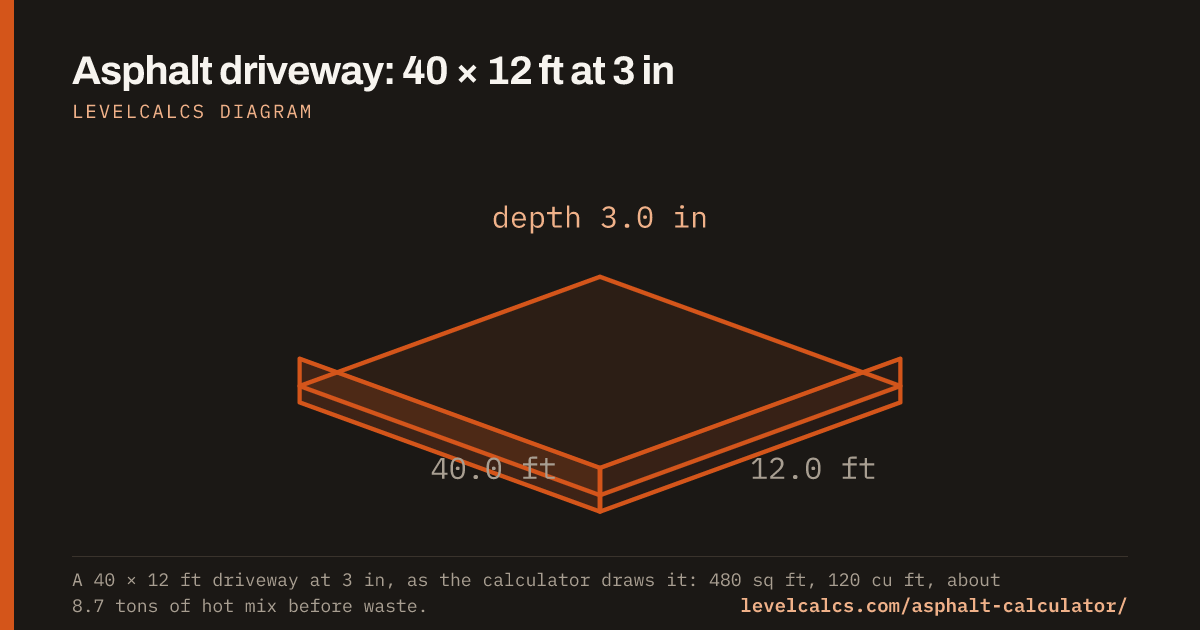
Asphalt is sold by weight. Work out the compacted volume, multiply by density (hot mix runs about 145 lb per cubic foot) and convert to tons. A 40 × 12 ft driveway at 3 inches is 120 cubic feet, which comes to roughly 8.7 tons before waste.
How thick should an asphalt driveway be?
Plan on three inches of compacted hot-mix as the residential minimum (2 in base course plus 1 in wearing course). Go 4–6 inches full-depth in cold climates or where heavier vehicles will use it.
Under it all you want 4–8 inches of compacted aggregate base. Soft or clay ground needs the thicker end, and it’s worth checking your local code or supplier before you settle on a depth.
How many square feet does a ton of asphalt cover?
How much space does a ton of hot mix take up? About 13.8 cubic feet once it’s been rolled, which is 2,000 lb divided by the 145 lb per cubic foot the compacted mix weighs. Spread that over a driveway and the coverage falls straight out of the thickness. Call it roughly 83 square feet at 2 inches, 55 at 3 inches, and 41 at 4 inches.
Those three numbers are worth memorizing, because they let you sanity-check a quote in your head. Say a contractor tells you your 800 square foot driveway needs 25 tons at 3 inches. You’ll know straight away that something’s off, since 800 divided by 55 is a touch over 14.5.
Coverage per ton isn’t really a property of the asphalt at all. It’s a property of the thickness you choose, and that’s why every asphalt tonnage calculator asks for depth before it asks for anything else. Double the depth and you halve the area a ton covers.
It also means coverage figures quoted with no thickness attached (a ton covers about 80 square feet, which you’ll see on plenty of supplier pages) are quietly assuming 2 inches. Blacktop, hot mix and dense-graded surface course are the same product for this purpose. The trade name changes by region. The density doesn’t move enough to matter at driveway scale.
Work the sum the other way and those same figures give you tonnage from an area you’ve already measured. Take the square footage, divide by the coverage for your thickness, and you have tons before waste. An 800 square foot driveway at 3 inches is 800 divided by 55, or 14.5 tons. The same driveway at 2 inches is 800 divided by 83, about 9.7 tons.
Almost five tons of difference for a single inch. No other choice moves the material bill that much, so get the thickness settled before you call the plant rather than while you’re on the phone.
Asphalt weight per cubic yard and coverage per ton, as tables
Square yards to tons: the 110 lb per square yard per inch method
Paving crews rarely think in cubic feet. They think in square yards and spread rate, and the industry rule of thumb (published by the Asphalt Institute in its Asphalt magazine) is 110 lb per square yard per inch of compacted thickness for a dense-graded mix. Divide your square footage by nine to get square yards, multiply by the thickness in inches, multiply by 110, then divide by 2,000 for tons.
Inverted, the same rule gives the field shortcut crews quote at each other. 2,000 divided by 110 is 18.2, so one ton covers about 18.2 square yards at 1 inch, 9.1 square yards at 2 inches, and 6.1 at 3 inches.
The trade calls this ratio of tons placed to area covered the asphalt yield, and it gets checked on every job that matters. If the tickets say 15 tons went down but the mat only measures 80 square yards at 3 inches, the yield is out. Somebody is going to ask whether the screed sat high, the base was soft, or a load went somewhere else.
The 110 figure is a national average rather than a law. Illinois DOT specifies 112 lb per square yard per inch, Tennessee uses 106, and open-graded friction courses run far lighter still, with TDOT putting those at 88. In Canada the equivalent references are the provincial standards, Ontario OPSS 1150 and the MTO Superpave designations. For dense-graded residential work, anything from about 100 to 112 is normal.
The reassuring part is that the square yard method and the cubic foot method agree with each other. Convert 145 lb per cubic foot into spread rate (multiply by nine square feet, divide by twelve inches) and you get 108.75 lb per square yard per inch. The two routes land inside about one percent.
Use whichever suits the numbers you already have in front of you. If the quote was written in square yards, the 110 method saves you a conversion. If you measured the drive in feet with a tape, stay in cubic feet and let the calculator do the arithmetic.
Why this asphalt tonnage calculator uses 145 lb per cubic foot
Most compacted hot mix lands somewhere between 140 and 150 lb per cubic foot. The 145 used here sits in the middle of that band. The spread comes from the aggregate (a mix built on dense limestone weighs more than one built on a lighter local gravel) and from how well the mat was rolled. Getting density is the entire point of compaction, after all.
Choosing 145 keeps this calculator consistent with the 110 lb per square yard per inch spread rate the industry quotes, and it’s the figure nearly every supplier tonnage chart is built on. At driveway scale the uncertainty is minor. The pavement behind a 14 ton order comes to about 13.5 tons if the mix is really 140, and 14.5 if it’s really 150. Either end of the band sits only half a ton from the middle, and the waste allowance already absorbs that.
Note that the density figure describes compacted asphalt, not the loose mix that comes off the truck. Loose hot mix is roughly 20 to 25 percent bulkier than the finished mat, so a screed gets set at about 1.25 times the target compacted thickness. You lay 3.75 inches loose and roll it down to 3. That relationship is the real meaning of a compaction factor, and it’s a different thing from waste.
The slider on this page doesn’t correct the density, because the density is already a compacted number. It’s there for the material that genuinely disappears. Thick spots over a soft patch of base, handwork at the edges, and the last half-shovel left in the bed.
Thickness itself has a floor set by the mix rather than by preference. The rule is that a lift should be at least four times the nominal maximum aggregate size for a dense-graded mixture. A half-inch mix therefore wants a 2 inch minimum lift, and it simply won’t compact properly any thinner.
Residential driveways are typically specified at 2 to 3 inches of compacted asphalt over 6 to 8 inches of compacted aggregate base. Four inches is commonly cited as the baseline for full-depth construction, where the asphalt itself carries the load instead of a granular layer.
Asphalt millings calculator: density, compaction and real coverage
Millings go by a lot of names. Reclaimed asphalt pavement, RAP, millings once it’s been ground off an old road, and recycled asphalt or grindings in Canada. Whatever you call it, it’s the most recycled material in the United States by tonnage. NAPA’s annual industry survey put more than 101 million tons back into productive use in 2024 at a 99 percent reuse rate, with average RAP content in new mixes running close to 23 percent by weight.
What reaches a homeowner’s driveway is the coarse leftover: cheap, dark and perfectly serviceable at roughly $10 to $40 a ton (US, 2026) against $90 to $160 for hot mix. Select the millings option here and the calculator runs 115 lb per cubic foot, a deliberately conservative loose figure. Fair warning, though. The internet disagrees about this number more than any other on the page.
The FHWA’s user guidelines for RAP put the unit weight of milled or processed material at 120 to 140 lb per cubic foot, and its maximum dry density in granular base use at 100 to 125. Consumer cost guides routinely quote 90 to 120 lb per cubic foot instead, or 1.2 to 1.6 tons per cubic yard.
Compaction estimates scatter just as badly. Volume loss of 15 to 20 percent, 25 to 30 percent, and 30 to 45 percent are all stated confidently on page one of the same search. There’s no consensus to report and we’re not going to pretend otherwise. Treat roughly 1.4 to 1.9 tons per cubic yard as the honest rolled range, and take your supplier’s own weight ticket over any published table when you can get one.
In practice that means millings coverage per ton lands somewhere between about 57 and 70 square feet at a 3 inch finished depth, depending on whose density you believe and how hard you roll. If you intend to compact properly with a vibratory roller rather than just driving the car over it, push the compaction and waste slider toward its 15 percent maximum. That takes an 800 square foot driveway from 11.5 tons up to about 13.2, which is much closer to what a rolled 3 inch mat of millings really weighs.
Order the shortfall up front rather than chasing half a load later, because the next batch out of a stockpile rarely matches the first for gradation or color.
How many tons of asphalt for a 20 x 40 ft driveway?
Take a 20 x 40 ft driveway at 3 inches of compacted hot mix. It comes to 800 square feet, about right for a comfortable two-car apron. The volume is 800 multiplied by 0.25 ft, which is 200 cubic feet, or 7.4 cubic yards. At 145 lb per cubic foot that comes to 200 x 145 / 2,000 = 14.5 tons.
Cross-check it the paving way. 800 square feet is 88.9 square yards, times 3 inches, times 110 lb, divided by 2,000, giving 14.7 tons. The two methods sit about one percent apart, which is as close as this sort of estimating ever gets. Add the default 8 percent for compaction and waste and you’re ordering 15.7 tons. Call it 16, since plants sell in whole tons and a tri-axle hauls 18 to 22.
If your supplier quotes volume rather than weight, converting cubic yards to tons is straightforward once the density is fixed. A cubic yard of compacted hot mix is 27 x 145 / 2,000, or 1.96 tons. It’s near enough to two tons per cubic yard that the round number is safe for a first pass.
Going the other way from an area, square feet times thickness in inches divided by 324 gives cubic yards directly (324 being 27 cubic feet times 12 inches). So 800 x 3 / 324 returns the same 7.4 cubic yards you started with, and doubling it puts you back at roughly 14.8 tons. If any two of those three routes agree, your measurements are probably sound.
On cost, US hot mix in 2026 runs about $90 to $160 per ton picked up at the plant, with a national average nearer $115 to $125. So 15.7 tons is roughly $1,410 to $2,510 in material, or $1,880 at this calculator’s $120 default. Delivery adds $15 to $40 a ton on modest loads, and beyond about 30 miles expect $0.50 to $2 per ton per mile on top. Most plants also set a minimum order of a few tons.
None of that covers the aggregate base, the tack coat between lifts, the roller rental, or the sealcoating. Sealcoat wants six to twelve months for the mix to cure before the first coat goes on, then every three to five years after that.
Tons to cubic yards and square yards to tons, the full tables
How much does asphalt cost per ton delivered
In the US in 2026, budget $105 to $200 a ton delivered. Hot mix runs $90 to $160 at the plant gate, averaging $115 to $125. Haulage adds $15 to $40 a ton on a small load, or $0.50 to $2 per ton-mile once you’re past about 30 miles from the plant.
Where you live moves that number more than anything you can negotiate. California quotes $130 to $180 a ton and the Northeast $120 to $175, while the Southeast sits at $90 to $135. Orders above roughly 50 tons pull a 5 to 10 percent volume discount that a driveway will never qualify for.
Some yards price the truck rather than the tonnage ($40 to $80 an hour, or $4 to $9 a ton inside a 15 to 20 mile radius). Establish which basis you’re being quoted on before you compare two numbers. And read what the figure covers. A delivered ton is material on the ground. Base stone, tack coat, roller time and sealcoating are all separate lines.
In Canada the same mix is sold by the metric tonne and runs roughly C$150 to C$320 delivered, with Ontario and BC at the top of the band and the Prairies lower. Installed residential work lands at about C$3.00 to C$8.17 per square foot. Convert before you compare, because one tonne is 1.102 short tons.
How thick should an asphalt driveway be over gravel
Three inches of compacted hot mix over 6 to 8 inches of compacted aggregate is the standard residential build. It usually goes down as two lifts of about 1.5 inches each. If you’re paving an existing gravel drive, that stone only counts toward the 6 inches if it really is that deep, crushed, and dense-graded.
Prove the base before you pave it. Contractors proof roll by driving a loaded quad-axle over the whole drive (Wolf Paving uses 72,000 pounds) and watching for movement. Anything that flexes more than an inch gets dug out and rebuilt. That test is where old gravel drives usually fail, because the surface stone is rounded river gravel with no fines in it, and rounded stone never locks together.
Regrade, blend in crusher run, and compact to at least 95 percent of maximum dry density. If you’d rather not fight the base at all, the Illinois Asphalt Pavement Association’s substitution rate is 1 inch of asphalt for 3 inches of aggregate. It’s how a 4 to 6 inch full-depth drive skips the stone entirely.
Common questions
How many square feet does a ton of asphalt cover?
A ton goes about 80 sq ft at 2 inches thick, 55–60 sq ft at 3 inches, and 40–45 sq ft at 4 inches, assuming standard 145 lb/cu ft hot mix.
How much does asphalt cost per ton?
In the US in 2026, hot mix typically runs $90–160 per short ton picked up, with most suppliers around $110–125. Delivery adds $15–40 per ton on small loads. Canadian plants quote per metric tonne, roughly C$150–320 delivered.
Is asphalt cheaper than concrete?
Usually. An installed asphalt driveway runs roughly $3–9 per sq ft against $6–12+ for concrete. Bear in mind that asphalt needs sealing every few years.
What about recycled asphalt millings?
Millings are far cheaper and compact into a serviceable surface. Order them loose at about 115 lb/cu ft (1.5–1.6 tons per cubic yard) and expect roughly 25–30% compaction shrinkage once they’re rolled.
How much extra should I order?
Add 5–10% for compaction, an uneven base and the handwork at the edges. This calculator defaults to 8%, which usually covers a typical driveway.
How do I convert square yards of asphalt to tons?
Multiply square yards by the thickness in inches, multiply by 110 lb, then divide by 2,000. A 90 square yard drive at 3 inches is 90 x 3 x 110 / 2,000 = 14.9 tons before waste. Reverse it for coverage. One ton covers about 18.2 square yards at 1 inch, so roughly 6.1 square yards at 3 inches.
How many tons of asphalt are in a cubic yard?
About 1.96 tons for compacted hot mix at 145 lb per cubic foot, which is near enough to two tons that most people round it. Millings are lighter and far less certain. They run anywhere from roughly 1.2 to 1.9 tons per cubic yard depending on whose density figure you use and whether the material is loose or properly rolled.
How much does a ton of asphalt millings cover?
Somewhere around 57 to 70 square feet at a 3 inch finished depth, or about 85 to 105 square feet at 2 inches. The range is wide because published RAP densities run from 90 to 140 lb per cubic foot with no agreement between sources. If you can, get a weight ticket from your supplier’s stockpile rather than trusting a chart.
Is blacktop the same thing as asphalt?
For estimating purposes, yes. Blacktop, hot mix asphalt, asphalt concrete and dense-graded surface course all describe the same bound aggregate-and-binder material. They sit close enough to 145 lb per cubic foot that the tonnage doesn’t change. What varies is regional and trade vocabulary, not density, so use whichever term your supplier does.
What is a compaction factor, and is it the same as waste?
No. A compaction factor describes how much loose mix shrinks as it’s rolled, around 20 to 25 percent, which is why screeds are set at roughly 1.25 times the finished thickness. This calculator already works from compacted density, so the compaction and waste slider covers spillage, thick spots over soft base, and edge handwork instead.
Do I need a tack coat between asphalt lifts?
If you’re laying a base course and a wearing course on different days, or overlaying existing pavement, yes. Every state DOT requires one. Emulsion is typically applied at about 0.03 to 0.08 gallons per square yard of residual binder, more on a milled or aged surface. Without it the lifts behave as separate slabs and the top one slips.
Is there a minimum order for asphalt delivery?
Usually a full truckload. Most plants set the floor at 15 to 25 tons, though some run 5-ton minimums for residential work, and smaller operations will sell 2 to 5 tons with a small-load fee attached. A single-axle dump truck holds 6 to 8 tons if you’re collecting it yourself. Call the plant before you finalize anything.
Why does my asphalt quote expire after 30 days?
Because the binder is indexed. Liquid asphalt is only about 5 percent of the mix by weight, but its price swings hard. Maryland’s published index held at $640 a ton through most of 2025, dipped to $595 in February 2026, then climbed to $807.50 by that summer. Plants pass those monthly moves straight through.
Can I lay a small load of hot mix myself?
Realistically, no. Hot mix leaves the plant at 275 to 325°F and has to be spread and rolled before it drops below about 185°F, when it’s too stiff to compact. Lift thickness, air and ground temperature and wind set that window, and a thin lift on a cool day stiffens fast. Without a paver and a roller standing by you get a soft, permeable mat, so millings are the DIY-friendly option. Plants also shut for winter, and crews stop once it drops much below 50°F (10°C), which puts paving at roughly May to October across Canada and the northern states.