How much concrete do I need?
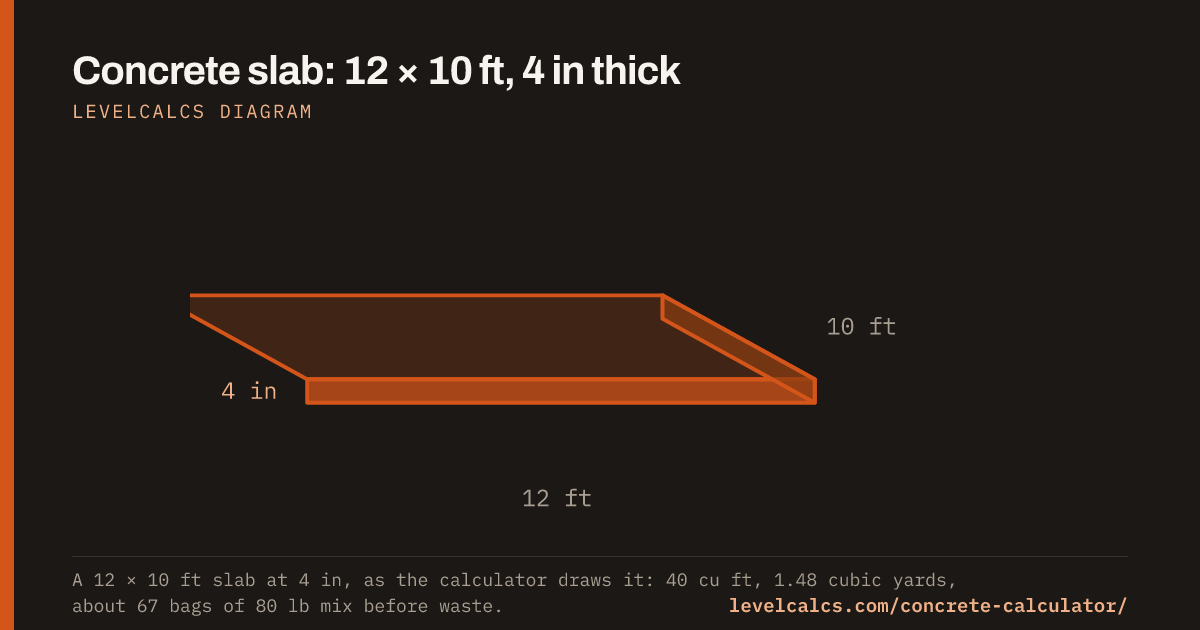
Concrete is sold by volume. Multiply length × width × thickness in the same unit, then convert (there are 27 cubic feet in a cubic yard). A 10 × 10 ft patio at 4 inches thick is 33.3 cubic feet, or about 1.23 cubic yards.
Always add waste. Subgrade is never perfectly flat and some concrete stays in the mixer. Around 5–10% is normal for a slab, and you’ll want more for footings dug in soft ground.
Bag yields and coverage
| Bag | Yield | Bags per cu yd | Bags per m³ |
|---|---|---|---|
| 40 lb | 0.30 cu ft | 90 | 118 |
| 60 lb | 0.45 cu ft | 60 | 78 |
| 80 lb | 0.60 cu ft | 45 | 59 |
| 90 lb | 0.68 cu ft | 40 | 52 |
| 30 kg (Canada) | 0.50 cu ft | 54 | 71 |
The bag count depends on the unit your supplier quotes in. A cubic yard is 27 cubic feet and a cubic meter is 35.31. Canadian plants quote cubic meters, and 30 kg is the only bagged size sold there (Quikrete, Sakrete and King all use it).
Bags for a 10 × 10 slab, worked through
Start with the volume, because every other number hangs off it. A 10 × 10 ft slab at the standard 4 inches is 33.3 cubic feet, or about 1.23 cubic yards before waste.
Add 5% for waste, divide by the 0.60 cu ft an 80 lb bag yields, round up, and you land on 59 bags. The table runs the same sum for the other sizes, at the usual allowance and at the higher one you’d use on a rougher base.
| Bag | Yield | Bags at 5% waste | Bags at 10% waste |
|---|---|---|---|
| 40 lb | 0.30 cu ft | 117 | 123 |
| 60 lb | 0.45 cu ft | 78 | 82 |
| 80 lb | 0.60 cu ft | 59 | 62 |
| 90 lb | 0.675 cu ft | 52 | 55 |
| 30 kg (Canada) | 0.50 cu ft | 70 | 74 |
10 × 10 ft at 4 in = 33.3 cu ft. US yields from the Quikrete Concrete Mix data sheet. The 30 kg figure is the Canadian Quikrete bag.
Now the part the calculator can’t show you. Fifty-nine bags weigh roughly 4,700 lb. Quikrete’s sheet wants 6 to 9 pints of water per bag, so you’ll be carrying something like 44 to 66 gallons to the mixer as well.
Call it twenty batches in a rental mixer, which is a long day. At the calculator’s default of $6.25 a bag (US big-box, mid-2026) the bags alone come to about $370, before the mixer rental and the fuel. The bags-or-ready-mix section below prices a truck against that.
Bags for other common slab sizes
The 10 × 10 is the size people search for, but it’s rarely the size they’re pouring. Here’s the same sum run across the slabs that come up most, all at 4 inches with the usual 5% waste.
| Slab (4 in) | Volume | Cubic yards | 80 lb bags | 60 lb bags | 30 kg (Canada) |
|---|---|---|---|---|---|
| 8 × 8 ft | 21.3 cu ft | 0.83 | 38 | 50 | 45 |
| 10 × 10 ft | 33.3 cu ft | 1.30 | 59 | 78 | 70 |
| 12 × 12 ft | 48.0 cu ft | 1.87 | 85 | 113 | 101 |
| 12 × 16 ft | 64.0 cu ft | 2.49 | 113 | 150 | 135 |
| 16 × 16 ft | 85.3 cu ft | 3.32 | 150 | 200 | 180 |
| 20 × 20 ft | 133.3 cu ft | 5.19 | 234 | 312 | 280 |
Length × width × 4 in ÷ 12, plus 5%, divided by the bag yield and rounded up. Yields from the Quikrete Concrete Mix data sheet.
Two things fall out of that table. Bag counts climb faster than the slab does, because area is what grows. And the 12 × 12 is roughly where mixing by hand stops being sensible.
Past about two cubic yards, most people are better off pricing a truck. The 16 × 16 needs 150 bags, which is close to two tons of lifting and a full day in a mixer. Have a look at the break-even below before you commit either way.
If the slab you’re pouring is a replacement, check the old one first. A slab that’s sound but out of flat usually wants a self-leveling underlayment rather than a fresh pour.
Footings and thickened edges
A slab that carries walls usually needs a footing, and a footing changes the order more than people expect. The IRC floor is 12 in wide and 6 in thick (R403.1.1), with the bottom at least 12 in below the undisturbed ground surface (R403.1.4), and below your frost line where that is deeper. Most trenches end up bigger than that, and the table gives the common sizes per foot of run.
| Footing (W × D) | Concrete per linear ft | 80 lb bags per 10 ft run |
|---|---|---|
| 12 × 6 in | 0.50 cu ft | 9 |
| 16 × 8 in | 0.89 cu ft | 15 |
| 20 × 10 in | 1.39 cu ft | 24 |
| 24 × 12 in | 2.00 cu ft | 34 |
Width × depth ÷ 144 gives cubic feet per foot of trench. Bags are rounded up and carry no waste allowance. Add 10–15% for a trench-poured footing.
Take the same 10 × 10 slab and give it a 12 in wide, 12 in deep thickened edge (a common shed and workshop detail). The band around the perimeter is 36 sq ft, and the extra depth under it adds about 24 cubic feet.
The pour grows to about 2.12 cubic yards, or from 59 bags to 101 with the same waste allowance. The edge covers a third of the footprint and takes closer to half the concrete. That’s the usual surprise.
Whether the footing has to reach the frost line depends on what it holds up. The IRC lets a freestanding light-frame accessory building of 600 sq ft or less, with eaves no higher than 10 ft, skip frost protection (R403.1.4.1). A deck that isn’t supported by the house gets the same pass. A heated addition doesn’t.
Trench-poured footings also swallow more than the drawing shows, because the sides slump. Allow 10 to 15% waste there rather than the slab’s 5.
Bags or ready-mix, and where the break-even sits
Bags win on small pours and lose fast once the volume climbs. At the default $6.25 a bag, a cubic yard in 80 lb bags costs about $281 (45 bags, US big-box, mid-2026).
Ready-mix in most US markets runs roughly $125 to $175 a yard delivered in mid-2026, more in the big metros. So the plant is usually cheaper per yard before you’ve even counted your weekend.
The catch is the short-load fee. Most plants want 3 to 4 yards minimum and charge around $60 to $150 for every yard you’re short. A 1.5 yard order can carry a fee bigger than the concrete. That’s what makes the 10 × 10 slab an honest toss-up on price (the table shows the range) and a clear win for the truck on effort.
| Pour | 80 lb bags | Ready-mix concrete | Short-load fee | Ready-mix total |
|---|---|---|---|---|
| 0.5 cu yd | 23 bags · $144 | $63–88 | $150–375 | $213–463 |
| 1.25 cu yd (10 × 10 slab, rounded up) | 57 bags · $356 | $156–219 | $105–263 | $261–482 |
| 2 cu yd | 90 bags · $563 | $250–350 | $60–150 | $310–500 |
| 3 cu yd | 135 bags · $844 | $375–525 | none | $375–525 |
| 4 cu yd | 180 bags · $1,125 | $500–700 | none | $500–700 |
Bags at $6.25 each, no waste; ready-mix at $125–175 per yard; short-load fee at $60–150 per yard short of a 3 yard minimum. US, mid-2026. Many plants add a flat delivery charge on top, and a few bill a 1 yard minimum on the concrete itself.
Weight decides it for a lot of people before price does. A yard of concrete in bags is about 3,600 lb, more than one trip for most half-ton pickups, and a full pallet is 42 bags. Past about a yard, call the plant and ask for the minimum load and the short-load fee. Ask how close the truck can get, too. Anything beyond the chute moves by wheelbarrow (roughly nine loads a yard).
Price the two side by side before you decide.
What the plant will ask when you order
The dispatcher will want strength, air content, slump and a delivery window, in roughly that order. Strength comes first. In the US it’s quoted in psi and the residential code sets the floor by exposure. An interior or basement slab can be 2,500 psi, a porch or garage floor in moderate weathering wants 3,000, and severe weathering pushes that to 3,500 (IRC Table R402.2). Plenty of people order 4,000 anyway, for not much more money.
Most homeowners forget air entrainment. Outdoor flatwork in the code’s moderate and severe weathering zones needs 5 to 7 percent entrained air under the same table, and a driveway that sees de-icing salt needs it most. The exception is a garage floor you want steel-troweled smooth. There the code lets air drop to 3 percent if the strength goes up to 4,000 psi. Hard-troweling air-entrained concrete tends to blister and delaminate, which is why ACI 302.1R says not to specify it for that finish.
Slump is stiffness. A 4 in slump is a common order for hand-placed flatwork, and it’s tempting to ask the driver for a wetter load. Each gallon of water per yard buys about an inch of slump and costs roughly 5 percent of strength (NRMCA CIP 26). Once more than a quarter yard has come out of the drum, no more water is allowed. Order the slump you need and leave the hose alone.
| Slab | US strength (psi) | US air | Ontario / CSA A23.1 |
|---|---|---|---|
| Basement or interior slab | 2,500 | not required | 20 MPa, max 0.65 w/cm |
| Porch, steps, garage floor (moderate weathering) | 3,000 | 5–7% | 32 MPa, max 0.45 w/cm, air-entrained (C-2) |
| Same, severe weathering | 3,500 | 5–7% | 32 MPa, max 0.45 w/cm, air-entrained (C-2) |
| Footings | 2,500 | not required | 15 MPa, max 0.70 w/cm |
US columns from IRC Table R402.2 (weathering potential per Table R301.2). The table’s footnote c asks for air entrainment in interior slabs and footings that may freeze and thaw during construction, and some states amend the footing row upward. Canadian column from Ontario Building Code 9.3.1.6 and CSA A23.1 Table 2; other provinces differ in the details.
In Canada the order is in MPa with a CSA A23.1 exposure class attached. A garage floor or driveway that sees de-icers is Class C-2 (32 MPa, air-entrained, maximum 0.45 water-cement ratio), and Ontario’s residential code asks for the same for all exterior flatwork. Check your local code or supplier before you order, because provinces and even municipalities adjust these.
Pouring in hot or cold weather
Cold weather starts earlier than most people think. ACI 306R calls it cold whenever the air falls to 40°F or below, or is expected to, during the protection period. Fresh concrete that freezes before it reaches about 500 psi can be permanently weakened. Quikrete’s own sheet says to keep a slab from freezing for the first 48 hours and get insulating blankets on if 32°F is in the forecast.
Warm mixing water helps a bagged pour in the cold, and a curing compound shouldn’t go on if it’ll drop under 50°F within a day. Ontario’s code is blunter about it. Below 5°C the concrete has to go in between 10 and 25°C and stay at 10°C or more for 72 hours (OBC 9.3.1.9).
Hot weather is less about the thermometer than about evaporation. ACI 305R says to take precautions once the evaporation rate approaches about 0.2 lb per sq ft per hour, and a dry wind can manage that on a mild day. The risk is plastic shrinkage cracks that show before the slab has even set.
Set time also collapses in the heat. NRMCA CIP 12 charts initial set falling from about 12 hours at 50°F concrete temperature to around 3 hours at 100°F, so the finishing window closes fast.
So pour early, dampen the subgrade without leaving puddles, and rig a windbreak or a fog spray if it’s dry and gusty. Don’t sprinkle water on the surface to help the finish, and don’t let water be added to a load more than about 1.5 hours old. Then keep it wet. NRMCA wants at least 3 days of curing and Quikrete asks for 5 days in warm weather, 7 when it’s cooler.
Rebar, wire mesh or fiber
Does a 4 in patio need any steel at all? Under the IRC, no. R506 sets a minimum thickness of 3.5 in and says nothing about reinforcement in an ordinary slab on grade, so a patio or shed pad on a well-compacted base is legal plain. What steel does is hold a crack tight once it happens (it won’t stop the crack from forming), and that matters more for anything that carries a car.
Wire mesh (the 6 × 6 in sheet or roll) only works if it sits in the slab. It needs chairs or brick bits holding it around mid-depth before the pour. Hooking it up through wet concrete leaves it on the ground more often than not, and ACI 302.1R says not to lay it on the ground and pull it up.
Rebar does the same job with fewer surprises. A common driveway detail is #3 or #4 bars on a grid in a 5 to 6 in slab, and the spacing there is a design call rather than a code minimum.
The bag aisle will sell you fiber, so it’s worth knowing what it does. Synthetic microfibers at the usual low dose (around 0.5 to 1.5 lb per cubic yard) cut plastic shrinkage cracking. NRMCA is clear they don’t replace structural steel, let you thin the slab, or stretch the joint spacing (CIP 24). Quikrete’s Crack Resistant mix has the fibers in the bag, and the company says it removes the need for wire mesh in a slab on grade. That’s probably fair for a patio and a bit optimistic for a driveway.
Reinforcement doesn’t stop cracks, it decides how wide they get. Joints decide where they go. Cut or tool them at 24 to 36 times the thickness (ACI 302.1R), so every 8 to 12 ft on a 4 in slab, and Quikrete’s bag sheet is tighter still at 6 to 8 ft.
Common questions
How many 80 lb bags in a cubic yard?
Forty-five. An 80 lb bag of pre-mixed concrete yields about 0.60 cubic feet, and a cubic yard is 27 cubic feet.
How thick should a concrete slab be?
Four inches is the usual thickness for patios, walkways and shed bases. Go to 5–6 inches for driveways or anything carrying vehicles. If the slab has no separate footing, thicken the edges as well.
Do I need gravel under the slab?
Nearly always. About 4 inches of compacted gravel gives drainage and a stable base, and it’s worked out separately from the concrete. Use the gravel calculator for tonnage.
Bags or ready-mix?
Under about half a cubic yard, bags are fine. Above roughly a cubic yard, ready-mix delivery is usually cheaper per yard and much faster than mixing 45+ bags by hand. Ask about the short-load fee before you compare, though. Most plants surcharge orders under 3–4 cubic yards, typically $60–150 per yard short (US, 2026), and that can wipe out the saving on a 1–2 yard pour.
How much waste should I allow?
Somewhere around 5–10% for a slab on a well-prepared base. Allow more for footings in soft ground, where the trench sides slump and swallow extra concrete you didn’t plan for.
What strength concrete do I need?
A residential slab usually gets 3,500–4,000 psi, and a driveway 4,000–5,000 psi. In Canada the same slab is specified in MPa with a CSA A23.1 exposure class. An exterior slab exposed to de-icing salt is Class C-2 minimum (32 MPa, air-entrained, maximum 0.45 water-cement ratio). Bagged mixes come pre-blended, so Quikrete Concrete Mix is 4,000 psi and Quikrete 5000 is 5,000 psi.
Do I need a vapor barrier under the slab?
Under any slab inside a heated building, yes — the 2021 and 2024 IRC ask for a minimum 10-mil vapor retarder meeting ASTM E1745 Class A, laid straight under the slab with joints lapped 6 in (R506.2.3). The 2018 IRC allowed 6-mil, so check which edition your jurisdiction is on. A detached patio or shed pad does not need one.
Do I need rebar or wire mesh?
For a driveway or anything carrying vehicles, typically mesh or #3/#4 rebar at 16–18 in centers. A 4 in patio on a well-compacted base can usually get away with fiber mesh alone.
How many bags of concrete for a 10x10 slab?
For a 4 inch slab with 5% waste, about 59 × 80 lb bags, 78 × 60 lb or 117 × 40 lb (70 of the Canadian 30 kg bags). Go to 6 inches for a driveway and the 80 lb count climbs to around 88. That’s over two tons of bags either way, so price a short load before you commit.
Is it cheaper to buy bags or order a truck?
Under about a yard, bags usually win once the short-load fee is counted (most US plants charge $60–150 for every yard under a 3–4 yard minimum, as of 2026). Past two yards the truck is normally cheaper and always easier, since a yard of bags weighs about 3,600 lb and means forty-five bags of mixing. Get a quote for both.
What strength and slump should I ask for?
For a patio or interior slab, 2,500–3,000 psi is the code floor and 4,000 is a common order. Anything that freezes needs 5–7% entrained air (IRC Table R402.2), and a slab that sees de-icing salt wants the higher strength too. Ask for a 4 inch slump and don’t add water on site. Each gallon per yard costs roughly 5% of the strength.
Can I pour concrete in winter?
If the air is expected to drop below 40°F while it cures, treat it as cold-weather work (ACI 306R). Use warm water in a bagged mix, get it placed early in the day, and keep it from freezing for at least 48 hours with blankets or plastic. Concrete that freezes before it reaches about 500 psi never fully recovers.