Square feet per pallet
Ask the farm. The word pallet covers a range of more than 50 percent, and the count you divide your lawn by is the one number that moves your order most.
The common cuts are below. Slab pallets come out at odd figures because 16 by 24 in pieces don’t stack to a round number.
| Pallet | Covers | Hand rolls (10 sq ft) | Slabs (16 × 24 in) |
|---|---|---|---|
| Small pallet | 400 sq ft | 40 | about 150 |
| Standard pallet | 450 sq ft | 45 | about 170 |
| Large pallet | 500 sq ft | 50 | about 190 |
| Slab pallets (producer figures) | 399, 452 or 503 sq ft | 150, 170 or 189 | |
| Northern roll pallets | 600–700 sq ft | 60–70 | |
| Gertens full pallet | 640 sq ft | 64 |
Sod Solutions lists slab pallets at 399, 452 and 503 sq ft, and hand-roll pallets at 400, 450 and 500. Gertens in Minnesota stacks 64 rolls for 640 sq ft and sells a 32-roll half pallet. Those are the two ends of the normal range.
Roll and slab sizes
Piece size follows the grass. Cool-season turf (bluegrass, fescue, rye) is cut as rolls in the north. Warm-season turf (Bermuda, zoysia, St Augustine, centipede) is cut as slabs in the south, or as machine rolls for big jobs.
| Piece | Dimensions | Covers | Typical use |
|---|---|---|---|
| Mini hand roll | 40 × 18 in | 5 sq ft | northern retail, easy to carry |
| Standard hand roll | 2 × 5 ft (24 × 60 in) | 10 sq ft | the common northern roll |
| Long hand roll | 80 × 18 in | 10 sq ft | some northern farms |
| Slab | 16 × 24 in | 2.66 sq ft | southern warm-season turf |
| Big roll | about 42 in wide, machine laid | several hundred sq ft | commercial and sports fields |
A 16 by 24 in slab is 384 square inches, which is 2.66 sq ft. Some guides round that to 2.75 and the pallet counts drift. Divide by 2.66 and the numbers land on what the farm stacks.
How many pallets for a lawn
Farms sell whole pallets, so every fraction rounds up. These counts include 10 percent waste, which is the safe default for a lawn with a few curves.
Counts include 10 percent waste and round up to whole pallets, because farms sell whole pallets. 8,000 sq ft is about the turf on a quarter-acre lot. Ask the farm whether its pallet is 400, 450 or 500 sq ft before you divide.
| Lawn | With 10% waste | 450 sq ft pallets | 500 sq ft pallets |
|---|---|---|---|
| 500 sq ft | 550 sq ft | 2 | 2 |
| 1,000 sq ft | 1,100 sq ft | 3 | 3 |
| 2,000 sq ft | 2,200 sq ft | 5 | 5 |
| 3,000 sq ft | 3,300 sq ft | 8 | 7 |
| 5,000 sq ft | 5,500 sq ft | 13 | 11 |
| 8,000 sq ft | 8,800 sq ft | 20 | 18 |
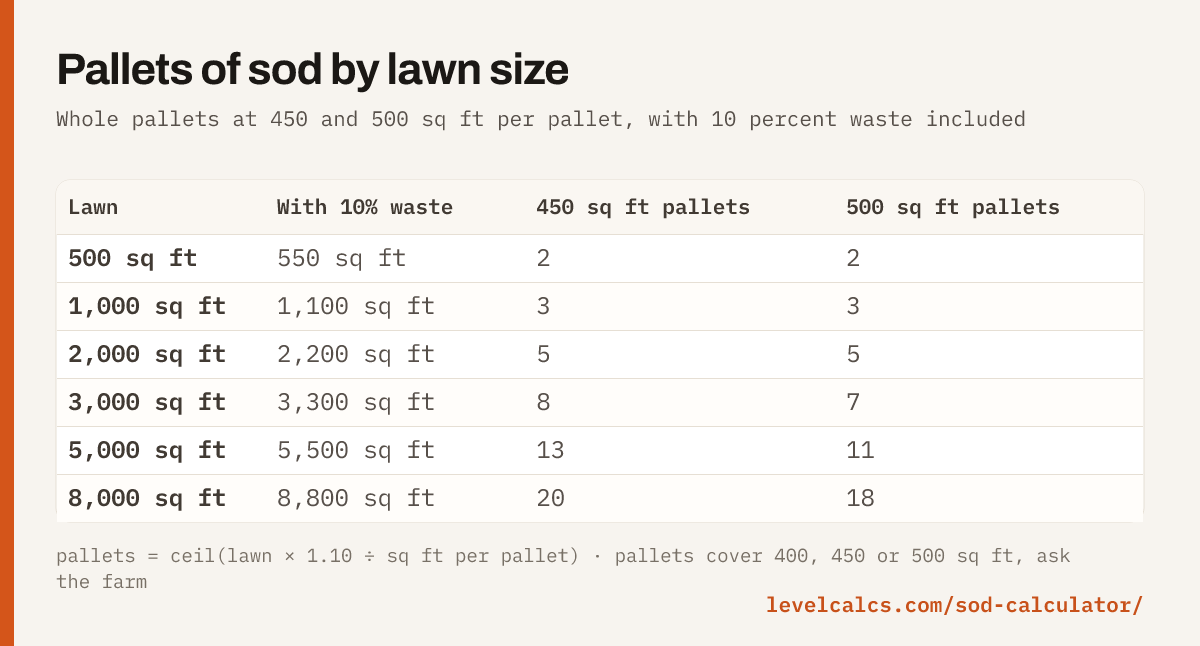
At 500 sq ft per pallet a 1,000 sq ft lawn is exactly two pallets with no allowance at all. That’s a poor bet on anything but a dead-square yard. Buy the third, or ask whether the farm will add a partial.
Why pallets aren’t a standard size
Pallet coverage is a harvesting decision, not a standard. The real limit is weight. A pallet has to be liftable by the forklift that loads it and the one that unloads it, and sod weighs 1,500 to 3,000 lb per 450 sq ft depending on how wet the field was. A farm on heavy clay stacks fewer square feet than a farm on sand.
Piece type is the other driver. Slabs stack in neat courses and the count lands wherever the stack height does. Rolls are bulkier, so roll pallets in the north often run bigger in square feet but similar in weight.
So ask three questions before you divide: square feet per pallet, piece size, and pallet weight. The first sets the order, the second sets the labor, and the third sets the truck.
Ordering pieces, pallets and partials
Order by square feet and let the farm convert to pieces. Counting pieces is a poor proxy when a pallet can be 45 rolls or 190 slabs, and quoting the farm an area removes the ambiguity.
Round up once, at the end. Measure the green area only, add 5 percent for a simple rectangle or 10 to 15 for curves and obstacles, then divide by the farm’s pallet figure and round up to whole pallets.
Partials are a pickup-only thing. Some farms will split a pallet if you collect, very few on a delivery. If you’re 50 sq ft over, it’s usually cheaper to buy the extra pallet than to pay a second delivery charge for a partial later.
Sources
Pallet coverages and piece sizes are the figures the producers below publish for their own product. Pallet counts are arithmetic on those figures.
Sod Solutions, square feet per pallet ↗Gertens, full pallet of sod rolls (640 sq ft) ↗The Grass Outlet, How many square feet are in a pallet of sod ↗Turfgrass Producers International ↗
Run your numbers
Enter the lawn size and the pallet coverage your farm quoted. The calculator rounds to whole rolls, slabs and pallets.
Common questions
How many square feet are in a pallet of sod?
Usually 450 sq ft. The common range is 400 to 500, slab pallets come in at 399, 452 or 503, and some northern roll pallets run 600 to 700. Confirm with the farm before you divide by it.
How many rolls of sod are on a pallet?
45 standard 2 by 5 ft rolls on a 450 sq ft pallet, 40 on a 400 and 50 on a 500. Northern suppliers that stack 64 rolls sell a 640 sq ft pallet.
How many pieces are in a pallet of sod?
About 170 slabs of 16 by 24 in on a 450 sq ft pallet, or 45 rolls if the farm cuts rolls. The number depends entirely on piece size, so ask for square feet rather than pieces.
What size is a roll of sod?
The standard hand roll is 2 by 5 ft and covers 10 sq ft. Mini rolls are 40 by 18 in for 5 sq ft, and some farms cut 80 by 18 in rolls that also cover 10 sq ft.
How many square feet is a piece of sod?
A southern slab is 16 by 24 in, which is 2.66 sq ft. A standard roll is 10 sq ft and a mini roll is 5 sq ft.
How much area will a pallet of sod cover?
A 450 sq ft pallet covers a lawn about 15 by 30 ft with no waste, or roughly 20 by 21 ft once you allow 5 percent for cuts. A 500 sq ft pallet covers about 20 by 25 ft.
How thick is sod?
About an inch including the soil, though the blade setting varies by farm and grass. That’s why the finished grade should sit an inch below every hard edge.