How much topsoil do I need?
Area times depth, converted to cubic yards. New sod usually wants 4–6 inches of decent soil and a seed bed about 3–4 inches. Raised beds get filled to their full internal depth, whatever that happens to be.
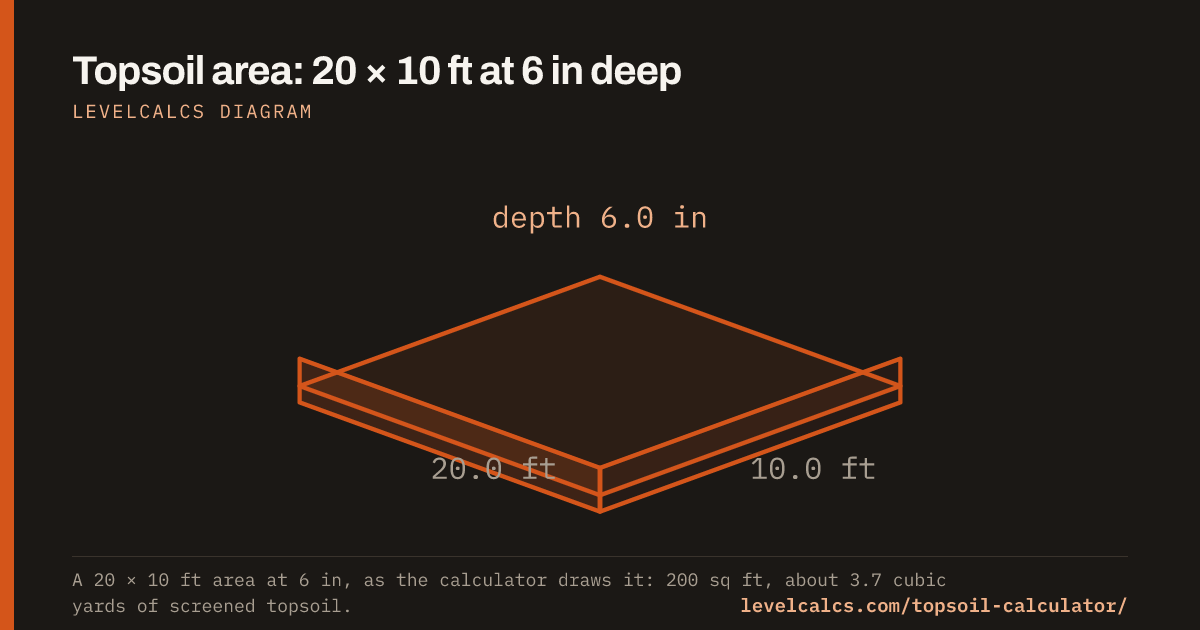
Measuring the job, and the depth mistake that doubles the order
Lawns and borders are rarely one clean rectangle. Break the job into shapes you can measure and add them together. A rectangle is length times width, a triangle is half the base times the height, and a circle is 3.14 times the radius squared. So a 12 ft diameter bed is 3.14 × 6 × 6 = 113 sq ft. Run the calculator once per shape at the same depth and add up the cubic yards.
The common error is measuring an irregular lawn at its widest point and treating the whole thing as a rectangle. On a plot that tapers from 25 ft across down to 15 ft, that one assumption puts you about 25 percent over before you’ve even chosen a depth.
The depth field causes far more grief than the area does. How deep is the dip, really? When you’re leveling an existing lawn or filling a hollow, the calculator wants the average deficit across the area rather than the deepest point. Peg a string line dead level across the low spot, measure down to the ground every couple of feet, then average the readings.
A dip that’s 4 in at the center and nothing at the edges usually averages 1.5–2 in. Order for 4 in and you’ve bought twice the soil you can use, and built a hump. For a new lawn the depth is real, because you’re laying a uniform layer over the whole area, so there the figure the calculator gives you is the one to buy.
Soil is quoted loose and finishes compacted, so the volume you spread isn’t the volume you end up with.
Fill settles anywhere from about 2 percent in sand to 20 percent or more in clay-heavy material. Most contractors add 10–15 percent when they’re building up a grade rather than dressing a surface.
Place it in 6–8 in lifts and compact each one if the ground will later carry a path, a shed or a patio. Skip compaction entirely and the settlement shows up as a dished lawn two winters later. Topdressing an established lawn is the exception. Never add a settlement allowance there, because the surplus you can’t use ends up smothering living grass.
Retaining wall calculator, if a slope needs holding back before the soil goes down
Screened, unscreened or blended: what you’re buying
No legal specification covers the word topsoil, so the name on the invoice tells you less than the stockpile does. Screened topsoil has been run through a mesh (half an inch is the common size) to take out stones, roots and clods. It’s what you want anywhere you’ll rake, seed, sod or plant. Unscreened topsoil and fill dirt keep the rocks, clay lumps and the occasional piece of brick. They’re for raising grade and rough earthwork where nothing has to look tidy.
Bulk topsoil runs roughly $12–55 a cubic yard for material alone (rough US figures for 2026), with screened material clustering around $35–55 and compost-enriched blends $35–75. Check your local supplier, since pricing swings a lot by region and by the season.
Go and look at the pile before you commit to a load, because no invoice description will tell you how much clay, stone or junk is sitting in it.
On any job deeper than about 8 inches, buy two products rather than one. Use cheap unscreened fill for the bulk of the depth and cap it with the 4–6 inches of screened topsoil that roots will occupy.
Take a 20 × 30 ft area raised by 8 inches. That’s 400 cubic feet, or just under 15 cubic yards.
All of it in a screened blend at $50 a yard comes to roughly $740 of material. Cap 7.5 yards of $20 fill with 7.5 yards of screened topsoil instead and the same finished result lands nearer $525. Run the calculator twice, once at the full depth for the total and once at your finished topsoil depth. The difference is what you order as fill.
Watch how the yard prices it, too. Soil is sold by volume but some suppliers bill by weight, and that conversion moves with the weather. A cubic yard of screened topsoil is around 2,200 lb reasonably dry. Across the full range from dry to saturated it spans roughly 1,500–3,000 lb, so a 15-ton load is about 13.6 cubic yards in a dry week and appreciably less after rain, for identical money.
Where you have the choice, buy by the cubic yard and take delivery when the pile has had a few dry days. Treat any per-ton quote as a figure you’ll need to convert before you compare it with anything else.
Delivery, access and moving it once it lands
Delivery is charged per trip rather than per yard, commonly $50–150 for anything up to about 15 cubic yards. The cheapest order is the one that arrives in a single load. Discover you’re two yards short after the truck has gone and you pay the entire delivery fee a second time, which is why a 10 percent margin on a large soil order is close to free insurance.
Minimums vary. Some yards won’t turn a wheel for under three yards, and if the whole job is under about a cubic yard, bagged soil is usually less painful than paying a delivery charge on a token load.
Hauling it yourself is where people misjudge weight rather than volume. Topsoil is heavy. A half-ton pickup has a payload of roughly 1,500–2,200 lb, so at 2,200 lb per cubic yard you’re carrying about three-quarters of a yard, not the two or three yards the bed would physically swallow. Soil fills a truck by weight long before it fills it by volume, and the loader operator won’t stop you.
A tandem-axle dump truck carries 10–14 cubic yards. Past about four yards, delivery is usually worth paying for even if you own a trailer.
Then there’s the hauling, which nobody costs. A 6 cubic foot contractor wheelbarrow is four and a half loads per cubic yard on paper. A full one holds close to 490 lb of topsoil, though, and no one pushes that up a plank or a ramp. Half-fill it and you’re at nine or ten trips a yard, more with a smaller garden wheelbarrow.
Think about where the truck can safely dump, as well. It needs firm ground and clear overhead space to raise the bed. Soil left on a lawn in summer kills the grass beneath it within a couple of days, and a wet pile stains pavers and concrete. A sheet of plywood or a builder’s tarp under the pile solves most of that.
How many 40 lb bags of topsoil in a cubic yard
Thirty-six, usually. A cubic yard is 27 cubic feet and most 40 lb topsoil bags hold 0.75 cubic feet, so 36 of them fill a yard.
Read the bag before you buy, though. The same 40 lb weight is packed at 0.5 and at 1.0 cubic feet by different brands, which swings the count from 54 down to 27.
Weight is only a proxy for volume, and a damp one at that, so the cubic-foot figure printed on the bag is the number to buy against. The economics are brutal at yard scale. Buying 36 bags at $3 to $4 each is $110 to $145, against roughly $35 to $55 for the same cubic yard delivered loose.
Weight beats you a second time in the parking lot. A yard of bagged soil is 1,440 lb, more than most cars are rated to carry and the better part of a half-ton pickup’s 1,700 to 2,400 lb payload. A pickup will usually take a yard in one trip. A car or crossover is three or four. Bags win below about a cubic yard, or where a truck genuinely can’t reach the work.
How much topsoil to level a yard 1 inch
An inch over 1,000 square feet is 83 cubic feet (3.1 cubic yards, roughly 3.4 tons). The multiplier is worth keeping in your head, because lawns are rarely a round 1,000 square feet.
Multiply your square footage by 0.0031 to get cubic yards at that depth, so a 5,000 sq ft lawn takes 15.4 yards, a fraction over a full tandem-axle load. Order it screened. Cloddy material won’t rake out that thin.
One inch is about right over bare soil you’re about to seed, and too much in a single pass over living grass. Half an inch is the ceiling there, so a full inch becomes two passes a season apart. Match the texture to what’s already under the lawn, too. A sandy topdressing over clay, or clay over sand, builds a distinct layer that water and air struggle to cross, and you’ll see it as a lawn that dries in patches.
Work the material in with a drag mat or the back of a landscape rake until the grass blades show through, then water it. And never level a hollow by measuring its deepest point. Average the deficit across the whole area instead.
French drain calculator, if the low spot is a drainage problem rather than a grading one
Can you put topsoil over existing grass?
Yes, but only about half an inch at a time. Any more buries the crowns, and the grass under it dies instead of growing up through. To raise a lawn a full inch or more, work in half-inch passes a season apart, or strip the turf, grade the subsoil and re-seed. Burying a lawn deeply is just a slower way of killing it.
Time it for the growing season, ideally straight after aeration so the material drops into the holes. Use a topdressing blend or a soil-and-compost mix rather than raw heavy loam.
Where the fill has to be deeper than an inch, kill or strip the grass first. A smothered turf layer rots down over a year or two, and the level you carefully built sinks in bands.
Keep new soil off the flare of tree trunks and out of shrub crowns, and stay shallow over surface roots. Piling several inches of soil over a mature root plate tends to suffocate it, and the tree usually tells you about it two summers later.
How many yards of topsoil in a dump truck load
Ten to 14 cubic yards on a tandem-axle truck, 5 to 8 on a single axle, 12 to 16 on a tri-axle. Those are body sizes, and the legal weight usually decides the load before the body does.
At roughly 2,200 lb a cubic yard, 14 yards is already 15.4 tons, and soaked soil gets you fewer yards for the same legal weight.
Work out what a load really does before you book one. Ten cubic yards covers 810 sq ft at 4 inches, 3,240 sq ft at a 1-inch dressing, or just 270 sq ft at a full foot. A single load is a new lawn on a small plot and a rounding error on a big one.
It also has to land somewhere. Ten yards heaps up around 15 ft across and 5 ft high, and the truck needs firm ground plus a lot of clear sky.
A tandem bed at full tip reaches 18 to 22 ft. Put a tarp or plywood under the drop point, don’t let the driver tip on a lawn in summer, and allow 25 ft of overhead. Walk the drop point for wires and branches first, since utility lines are only required to clear a road by about 14 ft.
How much soil to fill a 4x4 raised bed
A 4 × 4 ft bed filled 12 inches deep takes 16 cubic feet. That’s 0.59 cubic yards, or 22 of the 0.75 cu ft bags.
Halve that for a 6-inch bed at 8 cubic feet. Go the other way and it’s 24 cubic feet at 18 inches, or 32 cubic feet at 24 inches, which is 1.19 cubic yards.
One bed is squarely bag territory. Most yards won’t deliver under about three cubic yards, so a single 4 × 4 needs five beds’ worth of demand before bulk makes sense. Fill it proud, because a fresh mix settles an inch or two in the first season, and you’ll be topping up every spring anyway as the compost fraction breaks down.
Deep beds are where you can save money, but check the crop first. Lettuce and greens are finished by about 12 inches, while beets, carrots and chard want 18 to 24, and tomatoes, cucumbers and squash will run 24 to 36 given the chance.
Over open ground those roots simply carry on down into the native soil, so it’s usually safe to fill the bottom half of a deep bed with cheaper bulk topsoil and keep the good blend for the top. A bed standing on paving or a patio needs its full depth in soil, with nothing draining out the bottom.
Common questions
How much does a cubic yard of topsoil weigh?
Screened and reasonably dry, a yard comes in around 2,200 lb (1.1 tons). Wet soil can exceed 1.3 tons, so don’t trust a dry-weather figure after a week of rain.
Topsoil or garden soil?
Topsoil is the bulk fill. Garden or raised-bed soil has been amended with compost and typically costs several times more, so it’s worth using for the top layer only.
Should I till it into the existing ground?
Blend the first inch or two into the subsoil, yes. A sharp boundary between the two layers stops roots and water crossing it, so it’s worth the extra pass with the tiller.
How many bags of topsoil make a cubic yard?
Thirty-six of the common 0.75 cu ft bags, or 27 if you can find 1 cu ft bags (a cubic yard is 27 cubic feet). At typical bag prices that works out at several times the bulk rate, so bags only really make sense below roughly a yard, or where a truck simply can’t reach the work.
How much topsoil do I need to level a lawn?
Far less than most people order. Extension guidance for topdressing established turf is a quarter to half an inch per pass, and 1,000 sq ft at a quarter inch is only 0.77 cubic yards. Going deeper than half an inch in one go buries the crowns and kills grass, so it’s better to repeat annually than try to fix it all at once.
Can I use topsoil as fill dirt?
You can, but it’s the wrong material and an expensive one. Topsoil is organic and compressible, so it keeps settling under anything built on it. Use unscreened fill for structural depth, compacted in 6–8 in lifts, and save topsoil for the top 4–6 inches where the roots live.
How much soil does a 4 × 8 ft raised bed need?
Filled 12 inches deep, a 4 × 8 bed takes 32 cubic feet (1.19 cubic yards). At 10 inches it’s almost exactly one cubic yard. Most vegetables root happily in 8–12 inches of soil, so 12 in is a sensible standard, and any bed sitting on paving or concrete should be at the deep end of that.
Will topsoil settle after I spread it?
It will. Loose fill loses roughly 5–15 percent of its depth in the first year, more in clay-heavy material. Add 10–15 percent when you’re building up a grade, water it in, then re-check your levels before seeding or laying sod. A lawn laid over unsettled soil dishes visibly within a season or two.
How much does a yard of topsoil weigh wet vs dry?
Screened and reasonably dry, about 2,000 to 2,200 lb. Saturated, 2,700 to 3,000 lb, so the same yard can put on 500 to 800 lb after a wet week. Light, sandy screened soil can come in nearer 1,500 lb. Buy by the cubic yard where you can, and if you’re quoted per ton, take delivery after a few dry days.
How many 40 lb bags of topsoil cover 100 square feet?
For a 1-inch layer, eleven bags, since 100 sq ft at an inch is 8.33 cubic feet and a 40 lb bag holds 0.75. Double it to 22 bags at 2 inches, and 44 bags at 4 inches, which is about the point where a bulk load starts looking cheap.
Can I fill a raised bed with topsoil alone?
You can, but it crusts and compacts inside a box where nothing tills it. Aim for roughly 60 percent screened topsoil, 30 percent compost and 10 percent perlite or coarse sand by volume. In a 4 × 4 bed at 12 inches that’s 9.6, 4.8 and 1.6 cubic feet. Straight bagged garden soil is the same idea at four times the price.