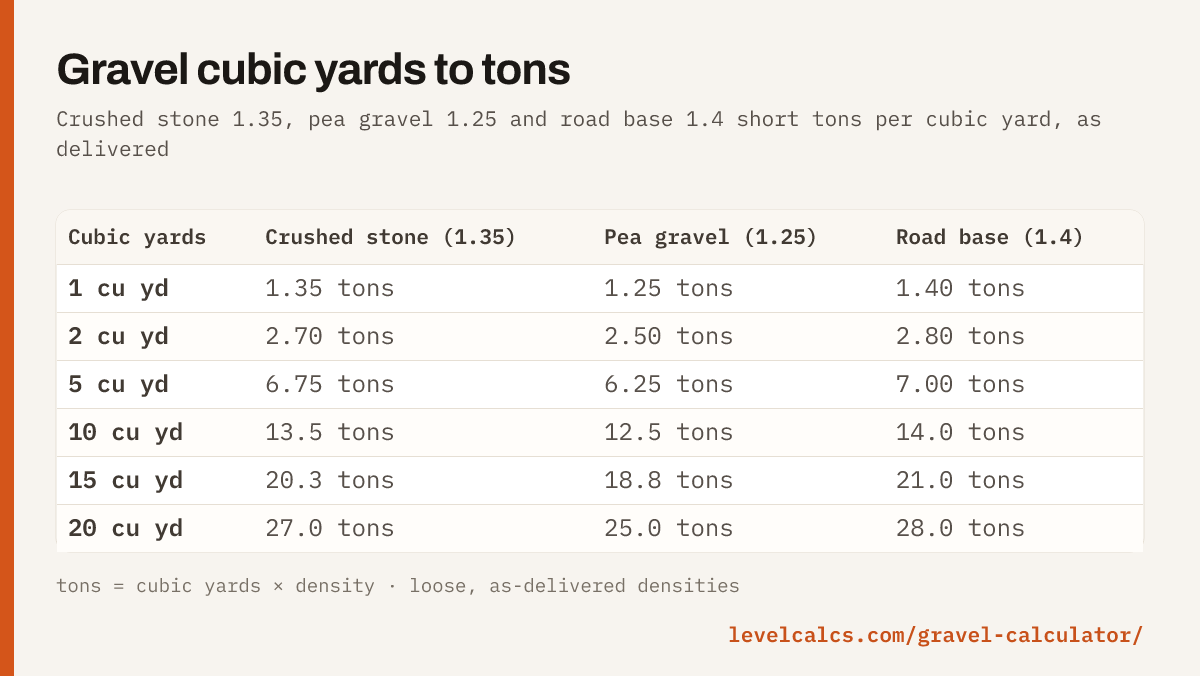
Cubic yards to tons of gravel, by material
Multiply cubic yards by the density of the material. Crushed stone is the usual pick for driveways and paver bases, so it’s the default in the calculator.
| Cubic yards | Crushed stone (1.35) | Pea gravel (1.25) | Road base (1.4) |
|---|---|---|---|
| 1 cu yd | 1.35 tons | 1.25 tons | 1.40 tons |
| 2 cu yd | 2.70 tons | 2.50 tons | 2.80 tons |
| 5 cu yd | 6.75 tons | 6.25 tons | 7.00 tons |
| 10 cu yd | 13.5 tons | 12.5 tons | 14.0 tons |
| 15 cu yd | 20.3 tons | 18.8 tons | 21.0 tons |
| 20 cu yd | 27.0 tons | 25.0 tons | 28.0 tons |
Tons to cubic yards of gravel
Divide tons by the density. Quarries quote by the ton, landscapers usually by the yard.
| Tons | Crushed stone | Pea gravel | Road base |
|---|---|---|---|
| 1 ton | 0.74 cu yd | 0.80 cu yd | 0.71 cu yd |
| 2 tons | 1.48 cu yd | 1.60 cu yd | 1.43 cu yd |
| 5 tons | 3.70 cu yd | 4.00 cu yd | 3.57 cu yd |
| 10 tons | 7.41 cu yd | 8.00 cu yd | 7.14 cu yd |
| 20 tons | 14.8 cu yd | 16.0 cu yd | 14.3 cu yd |
How much area does a ton of gravel cover?
Crushed stone at 1.35 tons per cubic yard. One ton is about 0.74 cubic yards, or 20 cubic feet.
| Depth | Coverage per ton | Coverage per cubic yard |
|---|---|---|
| 1 in | 240 sq ft | 324 sq ft |
| 2 in | 120 sq ft | 162 sq ft |
| 3 in | 80 sq ft | 108 sq ft |
| 4 in | 60 sq ft | 81 sq ft |
| 6 in | 40 sq ft | 54 sq ft |
Gravel base for a paver patio
4 in compacted base plus 1 in bedding sand. Base covers the excavation, which runs 6 in past the pavers on every side. Sand covers the paved area only.
| Patio size | Base (4 in) | Bedding sand (1 in) | Base in tons |
|---|---|---|---|
| 8 × 10 ft | 1.22 cu yd | 0.25 cu yd | 1.7 tons |
| 10 × 12 ft | 1.77 cu yd | 0.37 cu yd | 2.4 tons |
| 12 × 16 ft | 2.73 cu yd | 0.59 cu yd | 3.7 tons |
| 16 × 20 ft | 4.41 cu yd | 0.99 cu yd | 6.0 tons |
| 20 × 20 ft | 5.44 cu yd | 1.23 cu yd | 7.4 tons |
Worked examples by depth
Crushed stone at 1.35 tons per cubic yard, in-place volume with no compaction allowance added. The sections and questions below walk through each one.
| Job | Depth | Cubic yards | Tons |
|---|---|---|---|
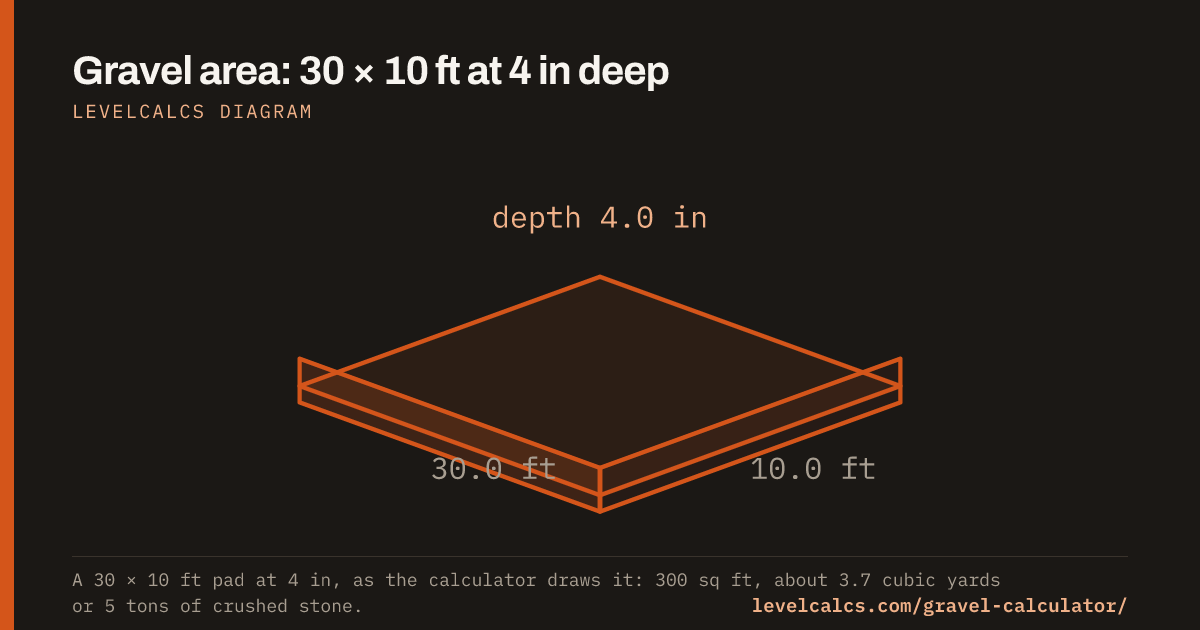
| 10 × 20 ft parking pad | 4 in | 2.5 cu yd | 3.3 tons |
| 10 × 20 ft parking pad | 6 in | 3.7 cu yd | 5.0 tons |
| 10 × 20 ft parking pad | 8 in | 4.9 cu yd | 6.7 tons |
| 20 × 20 ft parking pad | 6 in | 7.4 cu yd | 10 tons |
| 24 × 24 ft driveway | 4 in | 7.1 cu yd | 9.6 tons |
| 24 × 24 ft driveway | 6 in | 10.7 cu yd | 14.4 tons |
| 24 × 24 ft driveway | 10 in | 17.8 cu yd | 24 tons |
| 10 × 60 ft driveway on clay | 10 in | 18.5 cu yd | 25 tons |
| 14 × 18 ft shed pad (12 × 16 slab) | 4 in | 3.1 cu yd | 4.2 tons |
| 14 × 18 ft shed pad (12 × 16 slab) | 6 in | 4.7 cu yd | 6.3 tons |
Driveway layers by subgrade
Stone sizes follow ASTM D448 where a number is given. Depths are for mild climates; in freeze-thaw country build 8–12 in of compacted granular whatever the subgrade. Order each layer separately and run the calculator once per layer.
| Subgrade | Layer | Material | Thickness |
|---|---|---|---|
| Soft or clay | Coarse base | #2 or #3 stone (roughly 1–2½ in) | 4–6 in |
| Soft or clay | Middle | #57 or crusher run | 3–4 in |
| Soft or clay | Running surface | #411 or #8 | 2–3 in |
| Soft or clay | Total | three layers | 9–13 in |
| Firm, well-drained | Base | compacted crusher run | 4 in |
| Firm, well-drained | Running surface | surface stone | 2 in |
| Firm, well-drained | Total | two layers | 6 in |
How much gravel do I need?
A cubic yard of crushed stone is about 1.35 tons, pea gravel 1.25, road base about 1.4. Work out the volume first, then convert to tons with the density of whatever you’re buying. Then add a compaction allowance on top, because the depth you want is the finished depth and loose stone settles 15–20% under a plate compactor.
The worked examples on this page quote the in-place volume. The headline tonnage is the order quantity, so it runs about 15% higher.
How to convert cubic yards of gravel to tons
Multiply cubic yards by the density of the material in tons per cubic yard. Crushed stone is 1.35, pea gravel 1.25, sand and screenings 1.4, road base 1.4. So 10 cubic yards of crushed stone is 13.5 tons. To go the other way, divide. Ten tons of crushed stone comes to about 7.4 cubic yards.
The two units answer different questions, and that’s what trips people up. Cubic yards is what fits in the hole. Tons is what the supplier weighs on the truck scale and invoices you for. A quarry usually quotes by the ton, a landscaper by the yard, and the same delivery can be described either way. Check which unit a price is per before you compare two quotes (a $48 yard and a $48 ton aren’t the same purchase).
Every density here is in US short tons of 2,000 lb. Canadian yards quote per tonne of 2,205 lb, so 1.35 tons per cubic yard is 1.22 tonnes, and dividing a per-tonne price by 1.1 gives you the comparable price per short ton.
How deep for a driveway?
A residential driveway wants 4 inches of compacted base plus 1–2 inches of surface stone in mild climates. In freeze-thaw country (the northern US and most of Canada) build 8–12 inches of compacted granular over a separation geotextile. Only coastal BC and the US South can safely stay at 4–6 inches.
Soft or clay ground needs the thicker build either way, with a woven geotextile underneath so the stone doesn’t pump down into the subsoil. Check your local code or supplier before you settle on a depth.
Clean stone or dense-graded — the choice that decides everything else
Every gravel decision comes down to one question. Does the material still have its fines in it? Dense-graded aggregate (sold as crusher run, #411, DGA or road base depending where you are, and as Granular A in Canada) comes straight off the crusher. It’s graded continuously from a 3/4 in or 1½ in top size right down to rock dust.
Those fines are the entire point. A dense-graded base such as VDOT 21A runs 94–100 percent passing a 1 in sieve and 6–12 percent passing the No. 200, and PennDOT’s 2A allows 0–10 percent. Compacting drives that dust into the voids and locks the layer into something close to a soft pavement.
Clean stone such as #57 has been washed and screened to a nominal 3/4 in, running from 1 in down to the No. 4 sieve with the dust taken out. It will never bind, and it isn’t meant to.
That gives you a simple rule. Anything that carries a wheel, or that you want to stay where you put it, wants dense-graded material. Anything whose job is to move water (a French drain, a dry well, backfill behind a retaining wall, the layer under a shed base) wants clean washed stone.
Get it backwards and both failures are slow and expensive. Crusher run in a drain silts up and stops draining within a few seasons. Use #57 as a running surface and it rolls under tires, can’t be graded flat and steadily migrates into the lawn. The calculator’s material options follow the same split, since washed stone weighs slightly less per cubic yard than the same rock with its dust still in it.
Most proper driveways go in as two or three orders rather than one. On soft or clay subgrade you’re looking at a coarse base of #2 or #3 stone, a middle layer of #57 or crusher run, then a finer running surface. That’s 9–13 in in total (the layer table above has the sizes and the thickness of each layer). On firm, well-drained ground you can usually drop the coarse base and run 4 in of compacted crusher run with 2 in of surface stone over it.
Entering the full 10 in in one go gives the right total weight but nothing to tell the yard. Run the calculator once per layer at that layer’s depth and order each tonnage separately.
French drain calculator, for #57 stone around a perforated pipe
Compaction, moisture and the sanity check before you order
You buy gravel loose and it lives compacted, so the order is always bigger than the hole. Spread it in lifts of 4–5 in loose. Each one comes down to roughly 3–4 in compacted. Give every lift three or four passes with a plate compactor, overlapping each run by about half. Angular crushed stone usually locks up in three passes. Rounded gravel can take five and still never really gets there.
Dumping the full depth and driving on it for a month isn’t compaction — it consolidates unevenly and ruts. A 10–12 in compacted base is therefore three or four separate lifts, each spread, leveled and compacted before the next goes down.
Moisture affects both the compaction and the invoice. Dense-graded material compacts best slightly damp, so a light watering between passes genuinely helps. Bone-dry crusher run just shuffles around under the plate.
But you buy against a weighbridge ticket, and water is heavy. A load pulled from a stockpile that’s sat under a week of rain gives you measurably less stone per ton than the calculator’s dry density assumes. If you can’t wait for a dry spell, add a few percent and expect to be roughly right rather than exactly right. Buy in a dry spell if you have the choice of days.
Coverage per ton is the quickest sense check on any quote you’re given. A ton of crushed stone at 1.35 tons per cubic yard is about 20 cubic feet. That spreads to roughly 120 sq ft at 2 in and 60 sq ft at 4 in (the coverage table above fills in the rest).
Denser or rain-soaked material pulls that toward the 100 sq ft at 2 in many yards quote. So if a supplier tells you one ton will do your 300 sq ft path at 3 inches, they’re out by nearly four times.
Gravel cubic yards to tons, the conversion tables by material
Buying, delivering and topping up an existing driveway
Prices are all over the place. Figure roughly $15–75 a ton across the common grades (US bulk yards, mid-2026), with road base and crusher run at the cheap end around $15–30, plain crushed stone $30–55, pea gravel $28–45 and decorative river rock $45–100.
Delivery adds $50–150 per load within about 20 miles (US, mid-2026), most quarries hold a 5–10 ton minimum, and real bulk discounts usually start around 10 tons. That structure punishes small jobs twice. You pay the minimum load and then the delivery on top, so a 60 sq ft path is usually cheaper bought in bags, even at four or five times the per-ton rate.
Loads are limited by weight, not by the size of the bed. A tandem-axle dump truck is typically good for 12–16 tons, and because gravel runs 1.3–1.5 tons per cubic yard it hits the axle limit at roughly 8–12 cubic yards. That’s well short of the 10–14 yards the same truck would hold in mulch.
Ordering 18 tons therefore means two trips and two delivery fees. Trimming the job to 14 often means one. Ask the yard what their truck can legally carry before you finalize the depth, because half an inch off the surface layer can save a whole second delivery.
Topping up an existing driveway is the one case where the calculator’s assumption breaks. Lay a straightedge or a taut string across the driveway and measure down into the wheel tracks. If the tracks sit 2 in below sound shoulders, you need 2 in over the tracks only.
Enter the deficit, not the finished depth.
On a 12 × 60 ft driveway with two 3 ft wheel tracks that’s about 2.2 cubic yards, not the 8.9 that the full width at 4 inches would suggest. Plan on a top-up every one to two years to hold 4–6 in of stone, and regrade annually to keep a 2–4 percent crown (a quarter to half an inch of fall per foot from the center line).
How much gravel do I need for a driveway on clay soil
Clay needs a thicker build than firm ground. Plan on 8 to 12 inches of compacted stone instead of 4 to 6, plus a separation fabric on the subgrade. At 10 inches you’re buying about one ton per 24 square feet, so a 10 × 60 ft driveway works out at 18.5 cubic yards, roughly 25 tons.
Order it as layers and run the calculator once for each, because clay also eats the first lift. Proof-roll the subgrade with a loaded truck before you spread anything. If it ruts or pumps water to the surface, you’ll lose an inch or two of stone into the ground no matter how good the fabric is, so add ten percent to the base layer and expect it.
Where digging 12 inches is impractical (a driveway that has to meet an existing garage slab, say), a stabilization geogrid over the clay gets you the same performance in roughly half the aggregate. Tensar puts the reduction at up to 50 percent on granular access roads. Price the grid against the stone it saves before you decide.
Asphalt tonnage calculator, if the drive is getting paved on top
Do I need landscape fabric under a gravel driveway?
On anything softer than a clean sand or gravel subgrade, yes. Just not the landscape fabric sold as weed barrier. A driveway wants a proper separation geotextile, laid straight onto the compacted subgrade with 12 to 24 inch overlaps and run about a foot wider than the stone on each side.
AASHTO M288 treats separation, stabilization and subsurface drainage as three different applications, each with its own survivability class (Class 1, 2 or 3). It also says plainly that it isn’t a design guideline, so an ounce weight off a big-box roll tells you very little. Ounces per square yard is a non-woven convention in any case; wovens are specified on tensile strength.
M288 allows both constructions for separation and stabilization. Woven is the usual driveway pick because it carries tension and spreads wheel load, while non-woven goes in where the layer also has to drain, the same choice you’d make under a patio on clay. If a supplier quotes you a “Class 1A” fabric, that’s a code out of their own catalog, not an AASHTO class.
Skip the fabric entirely and clay pumps up into the voids under every wheel pass. A contaminated base stops draining, holds frost and ruts. The fabric belongs on the subgrade, never buried halfway up the stone.
Retaining wall calculator, for the base gravel and backfill behind a wall
How much gravel base under a 12x16 shed slab
Four inches of compacted clean stone, the base course thickness the IRC calls for under a slab on ground. Extend the pad 12 inches past the slab on every side, so you’re actually covering 14 × 18 ft. That’s 84 cubic feet, 3.1 cubic yards, about 4.2 tons. Over clay, go 6 inches and roughly 6.3 tons.
IRC R506.2.2 specifies a 4-inch base course of clean graded sand, gravel, crushed stone, crushed concrete or slag passing a 2-inch sieve wherever the slab sits below grade, with an exception only for well-drained Group I soils. Use washed 3/4 in stone rather than crusher run (the clean grading is what gives you the capillary break) and compact a 6-inch pad in two lifts, not one.
Two details save arguments with the inspector. R506.1 puts the slab itself at 3-1/2 in minimum, and the 10-mil vapor retarder required between slab and base is waived for unheated accessory buildings. The slab over that 192 sq ft floor is about 2.4 cubic yards of concrete at 4 inches.
Gravel parking pad thickness for cars, trucks and RVs
Four inches compacted is the minimum for cars and light trucks. Build 6 inches if you want it to last. Anything heavier (a loaded work truck, a travel trailer, a motorhome) wants 8 to 12. Over clay or in freeze-thaw country, add 2 inches to whichever figure applies.
Take a typical 10 × 20 ft pad, 200 square feet. At 6 inches that’s 3.7 cubic yards or about 5 tons. The worked-examples table above has the 4 and 8 inch figures. Build the 6-inch version as 4 inches of crusher run compacted, then 2 inches of angular surface stone.
Two things kill parking pads that driveways never see. The first is point loading. An RV stabilizer or a jack stand concentrates thousands of pounds onto a few square inches, so put a pad under it. The second is containment. Without a timber or steel edge, or a pad dug 6 inches below grade so it sits in a box, the stone tends to walk into the lawn.
How much crushed stone for a 24x24 driveway
A 24 × 24 ft driveway is 576 square feet. At a 6-inch build that’s 10.7 cubic yards, or 14.4 tons of crushed stone, about $690 at $48 a ton (US, mid-2026). Four inches drops it to 9.6 tons and 10 inches over clay pushes it close to 24 tons (the worked-examples table above has the yardage for each).
Buy it as two layers rather than one. Four inches of crusher run for the base, 9.6 tons, then 2 inches of surface stone, 4.8 tons, each spread and compacted before the next goes down. The tonnage matters for delivery as much as for cost. At 14.4 tons you’re right at the top of what a tandem-axle truck can legally haul, so ask the yard what their truck carries before you split the order and pay two delivery fees.
Excavate the full 6 inches plus an inch for the fabric. And since a 24 × 24 pad is really a two-car parking apron, put your top-up stone where the wheels track, not evenly across the whole square.
Common questions
How many tons in a cubic yard of gravel?
About 1.35 tons for crushed stone, 1.25 for pea gravel, and 1.4 for sand, screenings and road base, as delivered. Suppliers publish 1.2 to 1.4 depending on how wet and fine the mix is, so this calculator takes the top of the band and you don’t run short. Road base is often quoted at 1.5, but that’s its compacted density. Apply it to a loose load and you overbuy by about 10%. Rained-on loads simply weigh more.
How many cubic yards is a ton of gravel?
Divide by the density. A ton of crushed stone is about 0.74 cubic yards, pea gravel roughly 0.80. Spread out, a ton of crushed stone covers about 120 sq ft at 2 inches deep or 60 sq ft at 4 inches. Denser or rain-soaked material pulls that toward the 100 and 50 sq ft many yards quote.
How many cubic feet in a yard of gravel?
Whatever the material, a cubic yard is 27 cubic feet (3 × 3 × 3 feet). That never changes. Only the weight per yard changes, and that’s what the density figure handles.
What size gravel for a driveway?
For the base, a dense-graded crushed product (crusher run, #411, DGA or road base, Granular A in Canada) compacts hard. Finish with 3/4 in clean stone, usually #57. Rounded pea gravel never locks together and tends to migrate.
Do I need landscape fabric?
On soft ground, yes. A woven geotextile stops the stone sinking into the subsoil, and it roughly doubles the life of the drive. On clean sand or gravel you can usually skip it.
How many square feet does a ton of gravel cover?
For crushed stone at 1.35 tons per cubic yard, about 120 sq ft at 2 inches deep, 80 at 3 inches and 60 at 4 inches. Denser or rain-soaked material drops that toward the 100 sq ft at 2 inches many yards quote. Pea gravel is lighter per yard, so it covers a little more.
How much gravel do I need for a 20 × 20 ft parking pad?
At 6 inches, 400 sq ft is 200 cubic feet, or 7.4 cubic yards, about 10 tons of crushed stone. In practice you’d order it as two layers. Roughly 4 inches of crusher run base (6.7 tons) and 2 inches of surface stone (3.3 tons), spread and compacted separately.
How many tons of gravel fit in a dump truck?
A tandem-axle truck typically carries 12–16 tons. Gravel reaches the legal axle weight long before it fills the body, so that’s only about 8–12 cubic yards. If your order lands just over one truckload, shaving the depth slightly is usually cheaper than paying for a second delivery.
Do I have to compact gravel, or will traffic do it?
Traffic compacts unevenly and gives you ruts. Rent a plate compactor and work in 4–5 in loose lifts, three to four passes each with 50 percent overlap. Dampen dense-graded material first, because it won’t knit dry. Clean washed stone never truly compacts, which is why it belongs in drains rather than driveways.
What is the cheapest gravel for a driveway?
Road base and crusher run, typically $15–30 a ton (US, mid-2026), and they happen to be the right material as well because the fines bind under compaction. Recycled crushed concrete, where a local yard carries it, is usually cheaper still. Decorative river rock at $45–100 in the same market is both the most expensive and the worst performer under wheels.
How many wheelbarrows in a yard of gravel?
On paper, four and a half loads of a 6 cu ft contractor wheelbarrow. But crushed stone runs about 100 lb per cubic foot, so a full one is 600 lb and nobody moves that. Fill to half and count on 9 trips. A 3 cu ft homeowner wheelbarrow is 9 full loads at about 300 lb each. Plan on 9 to 14 trips per cubic yard, and rest the wheelbarrow on a plank if you’re crossing turf.
How many bags of gravel are in a cubic yard?
If you’re buying the standard 50 lb bag (Quikrete’s all-purpose gravel is the usual example), it takes 54 of them. Each holds 0.5 cubic feet and a cubic yard is 27 cubic feet. That also makes 40 bags to the ton. At typical bag prices you pay four to five times the bulk rate, so bags only make sense on small jobs or where a truck can’t reach.
Can I lay gravel directly on grass or dirt?
No. Gravel spread straight on a lawn looks fine for a season and is a rutted mess by the second winter. Strip the sod and the topsoil under it first, because that organic layer keeps decomposing and the stone sinks into the void it leaves. Dig to firm subsoil, compact it, lay geotextile, then build the stone up in lifts.
How much gravel do I need for a paver patio?
For a patio, four inches of compacted base. For a driveway, six to eight. Add one inch of bedding sand either way. Dig the base six inches wider than the pavers on every side so the edge restraint bears on stone, not soil. A 10 × 12 ft patio digs out at 11 × 13 ft and needs about 1.77 cubic yards of base, roughly 2.4 tons.
How much does a cubic yard of gravel weigh?
Crushed stone is about 2,700 lb (1.35 tons) per cubic yard, pea gravel around 2,500 lb. Wet material can run 10–15% heavier, so a load that’s delivered after rain weighs more for the same volume.