Bags of concrete per post hole
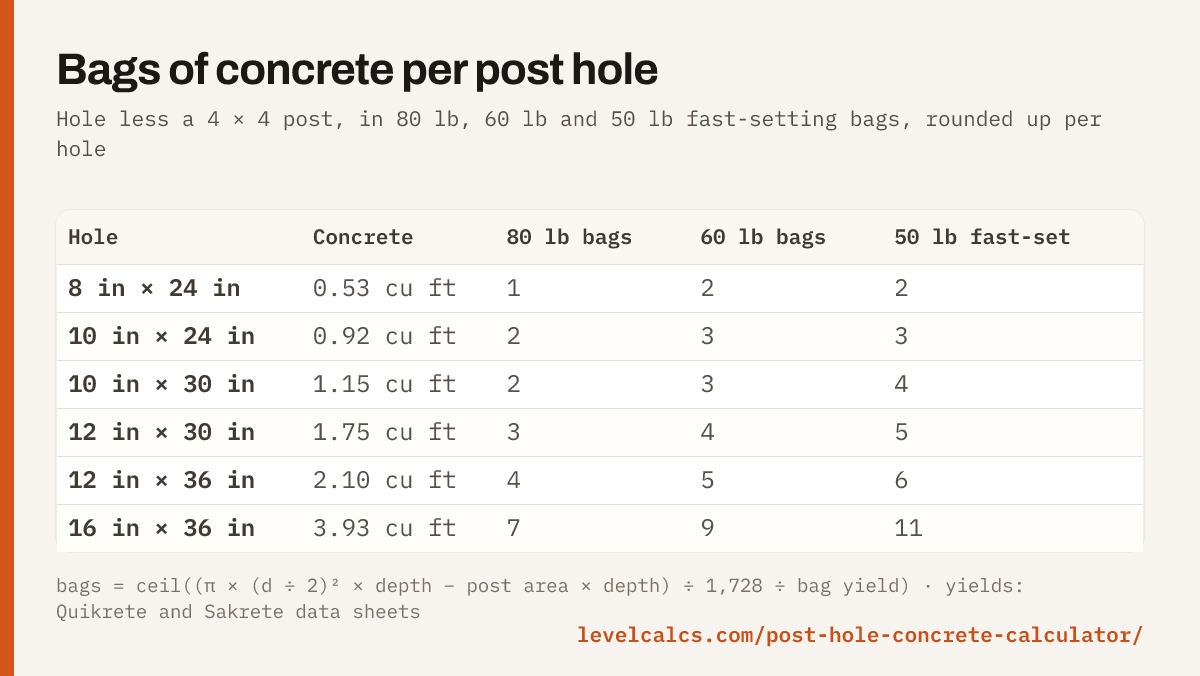
Concrete volume is the hole less the post (a 4 × 4 really measures 3.5 in). Fast-setting mix yields 0.375 cu ft per 50 lb bag. Standard mix gives 0.60 per 80 lb and 0.45 per 60 lb.
| Hole | Concrete | 80 lb bags | 60 lb bags | 50 lb fast-set |
|---|---|---|---|---|
| 8 in × 24 in | 0.53 cu ft | 1 | 2 | 2 |
| 10 in × 24 in | 0.92 cu ft | 2 | 3 | 3 |
| 10 in × 30 in | 1.15 cu ft | 2 | 3 | 4 |
| 12 in × 30 in | 1.75 cu ft | 3 | 4 | 5 |
| 12 in × 36 in | 2.10 cu ft | 4 | 5 | 6 |
| 16 in × 36 in | 3.93 cu ft | 7 | 9 | 11 |
Hole size and depth by post
Hole diameter is about three times the post width, and a third of the post goes below grade. Whichever is deeper wins, the one-third rule or your frost line. The frost-free column is only safe where the ground doesn’t freeze.
| Post | Fence height | Hole diameter | Frost-free ground | Frost country |
|---|---|---|---|---|
| 4 × 4 | 4 ft | 10 in | 24 in | 42–48 in |
| 4 × 4 | 6 ft | 10–12 in | 30 in | 48–60 in |
| 4 × 4 | 8 ft | 12 in | 36 in | 48–60 in |
| 6 × 6 | 6 ft | 16 in | 30 in | 48–60 in |
| 6 × 6 | 8 ft | 18 in | 36 in | 60 in |
Frost depth by city
Commonly cited municipal minimums. Confirm yours with the local building department, since they vary by county and by soil. Set the bottom of the hole below the number for your area.
| Depth | Where |
|---|---|
| 0–12 in | Florida, south Texas, coastal southern California |
| 18 in | Coastal BC — Victoria, Abbotsford, Port Coquitlam |
| 12–18 in | Mid-South — Atlanta, Dallas, Nashville |
| 36–42 in | Chicago, Denver, Detroit, Minneapolis |
| 48 in | Boston and Massachusetts, Toronto and the GTA, Hamilton, Calgary, Edmonton, Halifax, northern New England |
| 60 in | Ottawa, Quebec City, Red Deer, northern Minnesota, North Dakota |
| 72 in | Winnipeg, Regina, Grande Prairie |
| 84–96 in | Thunder Bay, Saskatoon |
How many bags of concrete per post hole?
Work out the hole as a cylinder, subtract the post that sits inside it, then divide by the bag yield. A 10 inch hole 30 inches deep is 1.36 cubic feet.
A 4×4 post (really 3.5 in) takes up 0.21 of that, which leaves 1.15 cubic feet, or just under two 80 lb bags. Round up per hole, because a half bag left in the wheelbarrow doesn’t help the next one.
How deep and wide should the hole be?
Two rules matter. The hole should be about three times the width of the post, and a third of the post should be underground. So a 6 ft fence post wants a hole roughly 10–12 inches across and about 2 ft deep, which means starting from an 8 ft post.
In frost country the bottom of the hole must also sit below the frost line, whatever the post height suggests. That pushes depth to 36–48 inches across the northern states and 42–48 in southern Ontario and the BC Interior. Around Ottawa and Montreal it’s 48–60, Alberta and the northern Prairies run 48–72, and Winnipeg and Regina sit at 72. Go by the frost depth your municipality publishes, even when the post height rule says shallower.
Frost depth, and why the one-third rule is only half the answer
The one-third rule tells you how much post to bury so it resists a lever. It says nothing about what the ground does in January. Where soil freezes, the water in it expands and lifts whatever it grips, and a post set above the frost line gets jacked up a little every winter and never quite settles back.
So how deep is deep enough? There are two depths, and you dig to the deeper one. The calculator on this page only turns a depth into bags, but the fence calculator here already runs the comparison (a third of the above-ground height against 6 in below your local frost line, with a 24 in floor). If you’re setting fence posts, start there and bring the depth across.
Frost depth is a local number, and usually not something you can guess from the climate. Your county or municipality publishes it, and the city table on this page is a starting point rather than a ruling. Check your local code or supplier before you dig, because the one-third rule can’t know it. The lever rule sizes the post. The frost line sizes the hole.
Bags per post and posts per bag
Start from the bags-per-post-hole table at the top of this page and round up per hole, not per job. The calculator’s default hole takes 1.15 cu ft once the 4 × 4 is subtracted, which is two 80 lb bags if you fill it to the top.
Manufacturers’ charts usually come out lower, and the gap is fill height. Quikrete’s sheet says two 50 lb bags set a 3 in square post in a 9 in hole 30 in deep. Quikrete stops the fill 3 to 4 in below grade, and its fast-setting guide and Sakrete both sit the post on a gravel base, so the concrete column is shorter than the hole.
Sakrete’s chart, for a 10 in hole, climbs from 1.25 bags at the shallow end to 3 for a deep one. You can’t buy a quarter of a bag, so a single shallow hole still takes 2, and pooling only helps when several holes are mixed in one barrow (the tip under the calculator explains the split).
Only small holes go the other way. A 4 × 4 mailbox post in a 6 in hole 2 ft deep needs under a quarter of a cubic foot, so one 80 lb bag mixed wet does two of them and most of a third.
Fence calculator, for the posts, rails and pickets of the whole run · How many bags of concrete per fence post, with Quikrete’s own figure and bags for a whole fence
Gravel-set or concrete-set
The fence page already covers why a concrete collar rots a post and why you crown it. So this is just the decision. Gravel suits line posts in ground that drains, because the post can be plumbed again later and water never sits against it. Concrete suits gate posts, corner posts and anything that takes a sideways load.
Clay is the deciding soil.
A gravel-filled hole in clay is a bucket, and the post stands in water until spring, so use concrete there and slope the top away from the wood. In sand or gravelly loam the opposite holds, and a well-tamped stone set often outlasts the rails.
Either way the post end sits on stone. Sakrete wants 4 to 6 in of compacted gravel under the post, this calculator allows 6, and Quikrete’s standard-mix instructions put 6 in of dry mix in the bottom instead. For a full gravel set, use angular crushed stone rather than rounded pea gravel (it never really locks up) and tamp it in thin lifts, a couple of inches at a time in a hole this narrow. Take the whole concrete volume as your stone quantity.
Fast-setting or standard mix, and when dry-pour is fine
Fast-setting mix exists so the bracing comes off the same hour rather than the next day. Quikrete’s sets in 20 to 40 minutes and takes load after 4 hours, while its standard Concrete Mix wants a full day before the post takes any strain.
Both finish at about 4,000 psi, and a 50 lb bag of either Quikrete mix yields the same 0.375 cu ft, so fast-setting buys time rather than strength. It usually costs more per cubic foot too (a smaller bag at a similar shelf price, US big-box, mid-2026). On a long run of line posts the standard mix is usually the cheaper fill, provided you can brace them for a day.
Dry-pour is fine with fast-setting mix, and only with fast-setting mix. Quikrete’s method is to brace the post, pour the dry mix to 3 or 4 in below the top of the hole, and add about a gallon of water per 50 lb bag until it’s saturated. Holes deeper than 30 in get two lifts, with the first left to soak through. Sakrete flips the order, water in first (a third of the hole) and then the dry mix.
Standard mix has to be mixed wet before it goes in, and it doesn’t like a sloppy batch either, since extra water is strength thrown away. Mix only what you can place in about 15 to 20 minutes with the fast stuff, keep the bags and the water above 40°F, and protect it all from freezing for 48 hours.
Common questions
How many bags of concrete for a 4x4 fence post?
For a typical 10 inch wide, 30 inch deep hole, two 80 lb bags. In a shallower 8 × 24 in hole it’s closer to one and a half, which is why the calculator rounds each hole up separately.
How many bags for 12 fence posts?
Around 24 × 80 lb bags for 10 × 30 in holes with 4×4 posts. If you’re dry-pouring fast-setting mix you can’t split a bag between holes, so buy the per-hole figure times twelve. If you’re mixing in a wheelbarrow, the pooled total is enough.
Should I put gravel in the bottom of a post hole?
Put about 6 inches of compacted gravel in, yes. It lets water drain away from the post end instead of sitting against it, and it’s about the cheapest thing you can do to add years to a wooden post.
Can I dry-pour concrete into a post hole?
With fast-setting mix, yes, and it’s the normal method. Brace the post, pour the dry mix to within 3–4 inches of grade, then add water per the bag. Standard mixes should be mixed properly before they go in.
How much concrete for a 16 inch Sonotube?
A 16 in tube 48 in deep holds 5.59 cubic feet — ten 80 lb bags — with no post displacement to subtract. Select ‘no post’ so the calculator uses the full cylinder.
Can I use this for deck footings?
For the concrete volume, yes. But a deck footing gets sized by load rather than post width. IRC R507.3 wants a footing bearing on undisturbed soil below the frost line, and many jurisdictions won’t accept a post simply embedded in a concrete-filled hole. Size the footing from your load tables or use a pier-and-bracket detail, then use this to get the volume.
How deep should a post hole be in frost country?
Deep enough that the bottom of the hole sits under the frost line, which the fence calculator here takes as 6 in below the published local figure. In frost-free ground the one-third rule governs instead. Whichever of the two is deeper wins, and a 24 in floor applies either way.
Can I set posts in gravel instead of concrete?
In soil that drains, yes, and for line posts it’s often the better choice, since the post can be re-plumbed later and never sits in water. In clay the hole turns into a bucket, so use concrete there and slope the top away from the post. Gate and corner posts want concrete regardless.
Does fast-setting concrete need to be mixed?
Not for posts. Pour it dry around a braced post, add about a gallon of water per 50 lb bag, and wait 4 hours before loading it. For a slab or a footing, mix it wet like any other concrete and work quickly, because you have around 20 minutes before it stiffens.