Mulch coverage per cubic yard
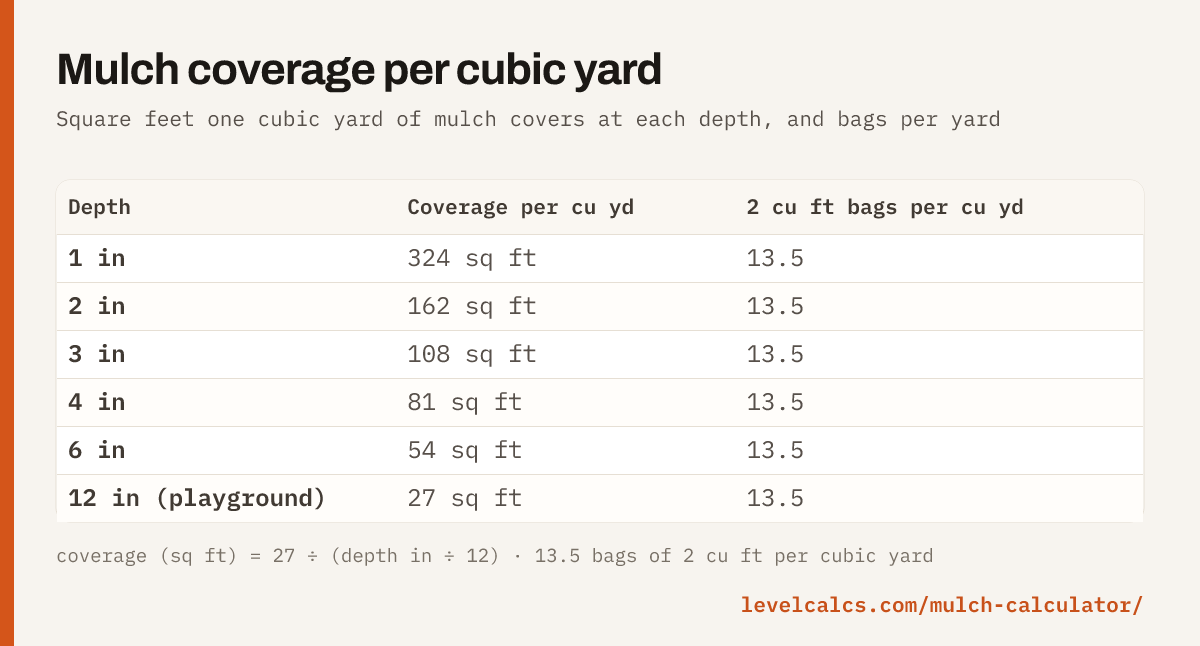
| Depth | Coverage per cu yd | 2 cu ft bags per cu yd |
|---|---|---|
| 1 in | 324 sq ft | 13.5 |
| 2 in | 162 sq ft | 13.5 |
| 3 in | 108 sq ft | 13.5 |
| 4 in | 81 sq ft | 13.5 |
| 6 in | 54 sq ft | 13.5 |
| 12 in (playground) | 27 sq ft | 13.5 |
How much area does a bag of mulch cover?
Coverage per single bag at the three common bag sizes.
| Bag size | At 2 in deep | At 3 in deep | At 4 in deep |
|---|---|---|---|
| 1.5 cu ft bag | 9 sq ft | 6 sq ft | 4.5 sq ft |
| 2 cu ft bag | 12 sq ft | 8 sq ft | 6 sq ft |
| 3 cu ft bag | 18 sq ft | 12 sq ft | 9 sq ft |
Mulch for common bed sizes at 3 inches
Bags are 2 cu ft, rounded up (the size big-box stores sell most).
| Bed size | Area | Cubic yards | 2 cu ft bags |
|---|---|---|---|
| 4 × 8 ft | 32 sq ft | 0.30 cu yd | 4 |
| 12 × 8 ft | 96 sq ft | 0.89 cu yd | 12 |
| 10 × 10 ft | 100 sq ft | 0.93 cu yd | 13 |
| 20 × 10 ft | 200 sq ft | 1.85 cu yd | 25 |
| 500 sq ft of beds | 500 sq ft | 4.63 cu yd | 63 |
| 1,000 sq ft of beds | 1,000 sq ft | 9.26 cu yd | 125 |
How much mulch do I need?
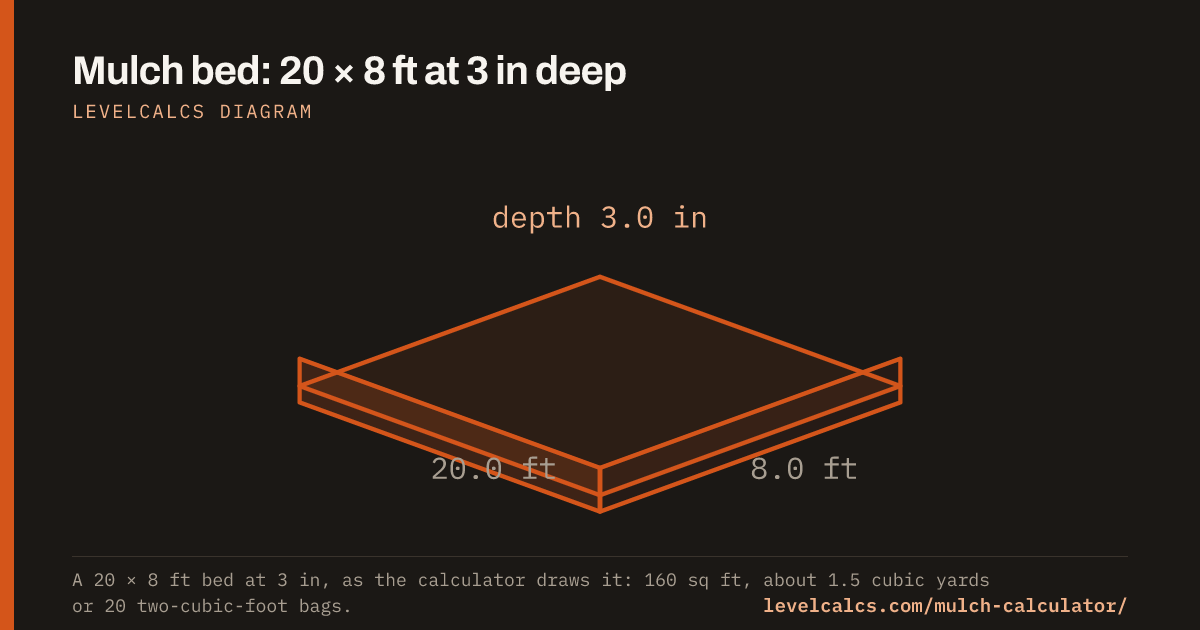
Multiply the bed area by the depth in feet, then convert to cubic yards (that’s the unit bulk suppliers sell in). One cubic yard covers roughly 108 square feet at 3 inches deep.
How deep should mulch be?
Two to three inches is the sweet spot for most beds. That’s enough to block light and hold moisture, but not so much that it suffocates roots. Keep it to 2 inches over shallow-rooted shrubs.
And never pile it against trunks (a mulch volcano rots bark).
Measuring curved beds without over-ordering
Beds are rarely rectangles. The quickest reliable method is the averaged-width strip. Walk the length of the border with a tape, measure the width at five or six evenly spaced points, and average those readings. A 40 ft border that runs 3 ft deep at one end and 7 ft at the other averages 5 ft, so it’s 200 sq ft. Measure at the fat end and treat it as uniform and you’ve bought 280 sq ft of mulch for a 200 sq ft bed.
Island beds are easier than they look. Split them into a rectangle plus two half-circles, or measure the long and short axes and use 0.785 × length × width (that’s the area of the ellipse most of them roughly approximate).
The second correction is planting. On a freshly planted bed the plants displace almost nothing, so mulch the full area. On an established foundation border the shrubs can take up 20–30 percent of the surface, and you’re not mulching under a mature juniper that touches the ground on every side. A shrub 4 ft across covers about 12 sq ft. Count the big ones, subtract their footprints, and leave the small stuff in. Being a bag short is a trivial fix. Being half a yard over means a pile sitting on your driveway until fall.
How deep, then? Pick the depth from the mulch you’re actually buying, not from habit. Fine stuff (shredded bark, leaf mold, grass clippings) packs down and seals over, so 2 inches is your working maximum with it. Coarse chips and bark nuggets let light and air through, and they need 3 to 4 inches before they shade the soil properly. That choice changes the order more than people expect. A cubic yard covers 162 sq ft at 2 inches, 108 at 3, and 81 at 4, so going from 2 to 3 inches is half as much mulch again, and 3 to 4 adds another third on top. So decide the depth before you measure anything.
Bags or bulk, and what it costs to move
The crossover sits around three cubic yards. Bulk mulch runs roughly $30–55 a cubic yard for the material (US landscape yards, mid-2026), with $50–120 on top for delivery, and many yards won’t deliver under 3–5 yards.
Bagged mulch is about $3–7 for a 2 cu ft bag (US big-box, mid-2026). Since 13.5 of those make a cubic yard, that’s roughly $40–95 a yard with no delivery fee at all. Below three yards the delivery charge swamps the material saving, so bags win. By five or six yards bulk is clearly cheaper. By ten it isn’t a close contest.
Mulch is about the one landscape material an ordinary vehicle can haul. A cubic yard of dry wood mulch weighs 400–800 lb depending on species (pine bark nuggets nearer 450, shredded hardwood 500–700), against about 2,200 lb for topsoil and 2,700 for crushed stone. So a half-ton pickup runs out of bed space before it runs out of payload, and two to three yards is a realistic load. Rain changes the arithmetic. Soaked hardwood can pass 1,000 lb a yard, so a heap that’s sat out through a wet week is a different proposition from the same heap in August.
Bags buy flexibility as well as small quantities. You can do one bed a weekend, store the surplus dry under cover, and match a later top-up by reading the color and product code straight off the bag (a bulk pile can’t give you that). Bulk buys price, and the freedom to stop counting. If you do go bulk, put a tarp down first. A wet pile stains pavers and concrete, and hardwood tannin marks are stubborn. Move it within a few days too, because a big fresh pile heats up inside, can turn anaerobic and sour, and sour mulch scorches foliage when you spread it.
How much a yard of mulch covers, with bags to yards and square feet to yards
When 2–3 inches is the wrong answer
Playgrounds run on a completely different set of numbers. CPSC public playground guidance treats loose fill as impact surfacing. Nine inches of compressed wood mulch protects a fall height of 7 feet, and 9 inches of wood chips protects 10 feet. The material compresses at least 25 percent in use, so you install roughly 12 inches and let it settle to 9. That turns a modest area into a serious order. A 20 × 20 ft play area at 12 inches is 400 cubic feet, just under 15 cubic yards, where the same 400 sq ft as a planting bed at 3 inches is only 3.7 yards.
In Canada the governing standard is CSA Z614. It asks for a 12 in (300 mm) minimum of loose fill and accepts ASTM F1292 or EN 1177 impact testing. Same order of magnitude, but cite CSA Z614 rather than the CPSC handbook on a Canadian job. Either way, if you’re mulching under equipment, calculate at the installed depth rather than the finished depth, and check the fall height of the tallest platform before you order anything.
The other exception is trunks and walls. Around trees, arborist guidance is 2–4 inches deep, held 3–6 inches clear of the trunk, and spread outward toward the drip line where the feeder roots are. A wide, thin ring uses no more material than a deep pile and does far more good. Against the house, keep mulch about 6 inches clear of siding and the top of the foundation, so there’s an inspection gap where termite mud tubes would show. Hold it under 2 inches within a foot of the wall too, so the soil can dry out. Both trim your order a little. Neither is optional.
Material choice changes both depth and lifespan. Shredded hardwood knits together and stays put on a slope, while bark nuggets float and end up at the bottom of any grade after one heavy storm. Cedar and cypress usually last longer before they break down. Pine straw (a Southeast material, rarely stocked north of the Carolinas and not sold in Canada) comes by the bale rather than the yard and covers roughly 35–40 sq ft at 2–3 inches, less over bare ground.
Dyed mulch is recycled wood colored with iron oxide or carbon black. It typically holds its color for most of a season to a full year, where undyed wood fades in one to three months. The pigments are benign. The question worth asking is what the wood was, since CCA-treated lumber only left residential production at the end of 2003 and old decking and demolition offcuts still reach the recycling stream.
Common questions
How many bags in a cubic yard?
A cubic yard is 27 cubic feet, so that works out to thirteen and a half of the 2 cu ft bags, or nine of the 3 cu ft bags.
How often should I re-mulch?
Top up once a year, usually. Organic mulch breaks down into the soil, so most beds only need about an inch a year rather than a full replacement.
Should I remove the old mulch first?
Only if it’s matted into a crust that water can’t get through. Otherwise just rake it loose and top up over it.
How many bags of mulch do I need for 100 square feet?
Depends on the depth. At 3 inches, 100 sq ft needs 25 cubic feet, which is 13 of the 2 cu ft bags or 9 of the 3 cu ft. At 2 inches it’s 17 cubic feet, so 9 and 6 respectively. A cubic yard covers 108 sq ft at 3 inches, so 100 sq ft is very nearly one bulk yard.
Should I put landscape fabric under mulch?
Not under organic mulch. The mulch decomposes into a seedbed sitting on top of the fabric, weeds root straight through the weave and get almost impossible to pull, and the fabric blocks worms and air from the soil below. Fabric earns its place only under materials that never break down (stone, river rock or rubber).
How much mulch do I need for a playground?
Far more than for a bed. CPSC loose-fill guidance calls for 9 inches of compressed non-CCA wood mulch to protect a 7 ft fall height, installed at about 12 inches to allow for the 25 percent compression the material undergoes in use. In Canada the same job is specified to CSA Z614, which likewise asks for a 12 in minimum of loose fill. A 20 × 20 ft area therefore takes roughly 15 cubic yards, and it’ll need raking level and topping up as it packs down.
Does wood mulch rob nitrogen from the soil?
Not while it stays on the surface. Decomposition happens in the thin zone where mulch meets soil, and that’s part of the reason it suppresses germinating weeds. The tie-up only becomes real if you dig or rototill wood chips into the root zone, where microbial demand competes directly with your plants for nitrogen.
Will a yard of mulch fit in my pickup?
Usually two or three will, by volume. Dry wood mulch is 400–800 lb per cubic yard against about 2,200 for topsoil, so a half-ton pickup runs out of bed space before it runs out of payload. Wet hardwood can exceed 1,000 lb a yard, though, so after heavy rain treat two yards as your ceiling.
How much area does one yard of mulch cover?
It depends on the depth. One cubic yard covers 162 sq ft at 2 inches deep, 108 sq ft at 3 inches, or 81 sq ft at 4 inches.