BTU by room size (ENERGY STAR)
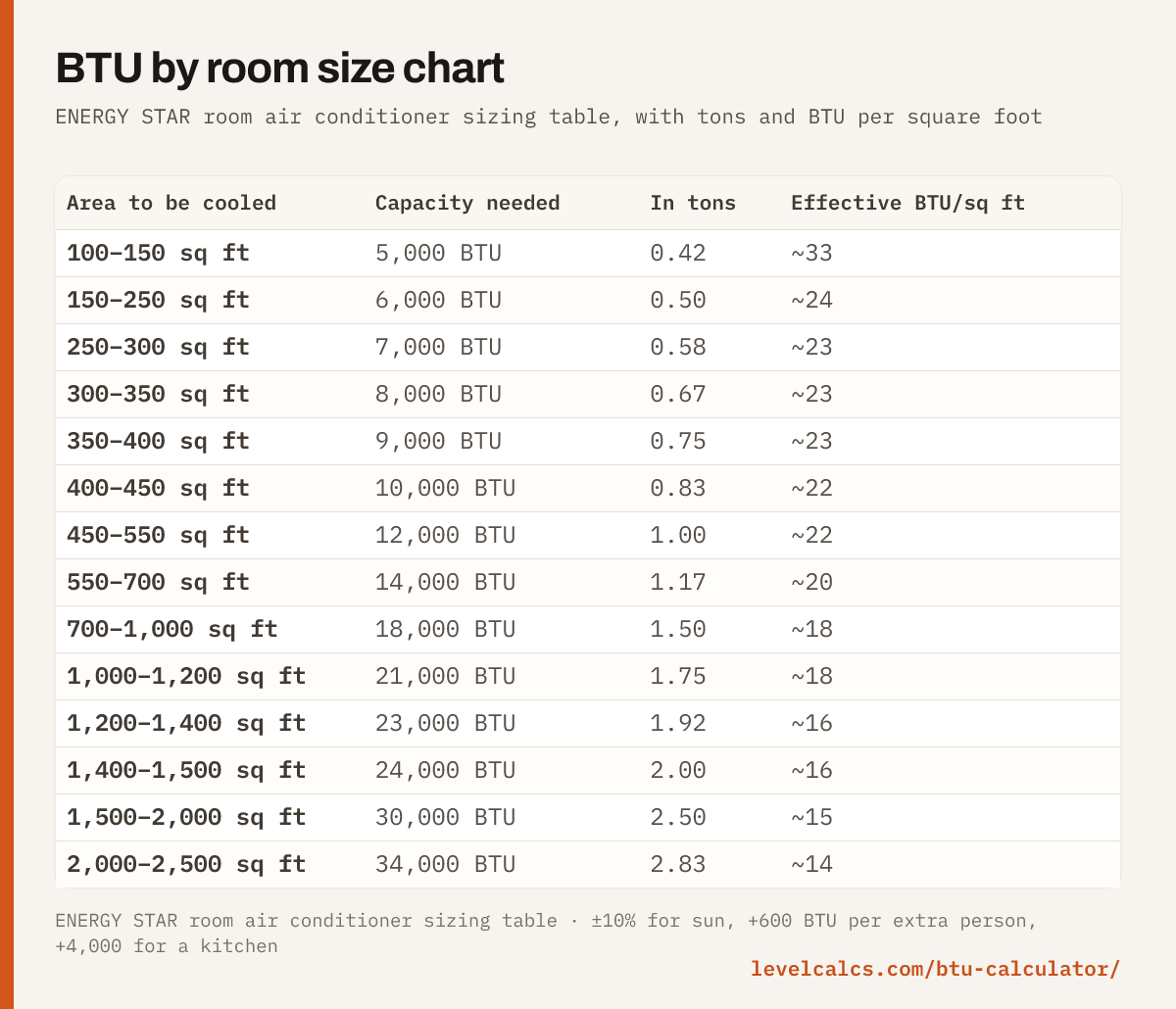
The official room air conditioner sizing table. Adjust ±10% for sun, +600 BTU per person over two, +4,000 for a kitchen.
| Area to be cooled | Capacity needed | In tons | Effective BTU/sq ft |
|---|---|---|---|
| 100–150 sq ft | 5,000 BTU | 0.42 | ~33 |
| 150–250 sq ft | 6,000 BTU | 0.50 | ~24 |
| 250–300 sq ft | 7,000 BTU | 0.58 | ~23 |
| 300–350 sq ft | 8,000 BTU | 0.67 | ~23 |
| 350–400 sq ft | 9,000 BTU | 0.75 | ~23 |
| 400–450 sq ft | 10,000 BTU | 0.83 | ~22 |
| 450–550 sq ft | 12,000 BTU | 1.00 | ~22 |
| 550–700 sq ft | 14,000 BTU | 1.17 | ~20 |
| 700–1,000 sq ft | 18,000 BTU | 1.50 | ~18 |
| 1,000–1,200 sq ft | 21,000 BTU | 1.75 | ~18 |
| 1,200–1,400 sq ft | 23,000 BTU | 1.92 | ~16 |
| 1,400–1,500 sq ft | 24,000 BTU | 2.00 | ~16 |
| 1,500–2,000 sq ft | 30,000 BTU | 2.50 | ~15 |
| 2,000–2,500 sq ft | 34,000 BTU | 2.83 | ~14 |
BTU for common room sizes
Base capacity before sun, occupancy or kitchen adjustments.
| Room | Area | BTU needed |
|---|---|---|
| 10 × 10 ft bedroom | 100 sq ft | 5,000 |
| 12 × 12 ft bedroom | 144 sq ft | 5,000 |
| 12 × 16 ft living room | 192 sq ft | 6,000 |
| 16 × 20 ft open plan | 320 sq ft | 8,000 |
| 20 × 20 ft garage | 400 sq ft | 9,000 |
| 24 × 24 ft double garage | 576 sq ft | 14,000 |
What size AC do I need?
Start from the ENERGY STAR bracket for your floor area (the table on this page lists every size), not from a flat per-square-foot rate.
Then adjust for the room. Scale up for ceilings over 8 feet, add 10% for a very sunny room (or take 10% off for a shaded one), add 600 BTU for each person beyond the second, and add 4,000 BTU if it’s a kitchen.
Cross-check the answer against the ENERGY STAR bracket table
The 20 BTU per square foot rule is a straight line and real sizing is not. ENERGY STAR publishes a bracket table for room air conditioners that runs 5,000 BTU per hour for 100 to 150 square feet, 6,000 for 150 to 250, 7,000 for 250 to 300, 8,000 for 300 to 350, 9,000 for 350 to 400, 10,000 for 400 to 450, 12,000 for 450 to 550, 14,000 for 550 to 700 and 18,000 for 700 to 1,000. Do the division and the implied rate falls as the room grows: about 33 BTU per square foot at 150 square feet, 24 at 500, and 18 at 1,000. Small rooms carry proportionally more wall, window and ceiling per square foot of floor, and the bracket table is quietly absorbing that.
Use the two together. If this calculator and the bracket table land in the same box, buy that size and stop reading. If the calculator pushes you just over a boundary (say 12,400 BTU against a 12,000 bracket), take the smaller unit rather than the larger.
Equipment only comes in fixed nominal sizes anyway. ACCA Manual S, the standard the trade sizes to, puts cooling equipment at roughly 90 to 115 percent of the calculated load, so rounding down to the nearest nominal size is the right call a good deal more often than rounding up.
The adjustments this calculator applies are ENERGY STAR’s own, and they’re worth applying properly because they compound. Cooking is a big, concentrated heat and moisture load, so a kitchen adds 4,000 BTU per hour. Beyond that, take 10 percent off for a heavily shaded room, add 10 percent for one in intense sun, and add 600 BTU per hour for each person past two who’s regularly in the room.
Stack all of that on a 300 square foot sunny kitchen that seats six. The base 7,000 BTU picks up 700 for sun, 2,400 for the extra people and 4,000 for the cooking, and ends up at 14,100 BTU per hour.
BTU to square feet chart, the ENERGY STAR table both ways with the adjustments
When 20 BTU per square foot is the wrong number
Twenty BTU per square foot assumes an ordinary insulated room inside a conditioned house, with an ordinary amount of glass. Remove any of those conditions and it breaks. A sunroom or three-season room glazed on three sides can need close to double. A converted garage, or a room directly beneath an uninsulated roof, will usually run well over. A west-facing room with a large unshaded window gains heat all afternoon regardless of its floor area.
It fails the other way too. The traditional 400 to 600 square feet per ton that suits older housing stock stretches to 1,000 to 1,500 square feet per ton on a tight, well-insulated modern envelope. Apply the old rule to a new build and you’ll buy a system roughly twice the size you need.
This is the whole argument for a real load calculation. ACCA Manual J works from your actual construction (insulation levels, window area and orientation, glazing type, air leakage, duct losses and local design temperatures) rather than a per-square-foot average that knows none of it.
An HVAC contractor should be quoting from that calculation on anything ducted or whole-house. If a proposal comes in two nominal sizes above the rule of thumb, that gap needs explaining, and you’re entitled to ask to see the printout. Treat any per-square-foot figure, including this one, as a sanity check on a quote rather than a specification.
In Canada the equivalent standard is CSA F280, and the Ontario Building Code makes it mandatory for equipment sizing, so ask a Canadian contractor for the F280 report instead.
So what does an oversized unit get wrong? Cooling capacity splits into sensible cooling, which drops the temperature, and latent cooling, which removes moisture. Moisture only leaves the air while the coil is running. An oversized unit reaches setpoint in a few minutes, shuts off, and never runs long enough to dehumidify.
You end up at 72 degrees and 65 percent relative humidity. Clammy, with mold starting in the corners. Sizing errs low in humid climates for that reason. Inverter and variable-speed equipment, which can run continuously at part load, tolerates a generous size far better than a single-stage unit does.
Heating BTU, and reading the number on the box
Heating uses the same unit and different numbers. Plan on 30 to 60 BTU per hour per square foot across the continental US, with the hot southern zones at the bottom of that band and the cold northern ones at the top. In Canada start at 40 and expect 60 or more in climate zones 7A, 7B and 8.
Back on the US band, a 2,000 square foot house lands somewhere between 60,000 and 120,000 BTU per hour. That spread is wide enough that the rule only tells you which class of appliance to look at, so a proper load calculation earns its fee on the heating side too.
Watch input against output on gas equipment too. A 100,000 BTU furnace at 95 percent AFUE delivers 95,000 BTU per hour into the house, and the nameplate figure is normally the input. One watt is 3.412 BTU per hour, so the usual 1,500 watt plug-in heater puts out about 5,120 BTU per hour. That suits a small bedroom and nothing larger. It also draws 12.5 amps, past the 12 amp continuous limit on a 15 amp circuit, so it really wants a 20 amp circuit to itself. Plug it straight into the wall, never into an extension cord or power strip. Check your local code, or ask an electrician, if you are unsure.
Hydronic baseboard (the hot water kind) is rated at roughly 510 to 600 BTU per hour per linear foot with 180 degree water, falling to about 300 to 320 at 140 degrees. So low-temperature heat pump conversions need noticeably longer runs of it.
The rating printed on the box isn’t always comparable between formats. Window units and mini-splits are rated the same way, but portable air conditioners carry two figures. One is an older ASHRAE number. The other is the Department of Energy’s SACC (seasonally adjusted cooling capacity), which is measured closer to real operating conditions and comes out 25 to 45 percent lower.
A portable sold as 14,000 BTU is typically about 9,000 BTU SACC, and anywhere from 7,700 to 10,500 depending on the model. Size a portable on its SACC figure only. Single-hose designs sit at the bottom of that spread because they exhaust conditioned air outdoors and pull unconditioned air in through every gap to replace it.
Common questions
What does a ton mean?
A ton of cooling is 12,000 BTU per hour, so a 24,000 BTU unit is a 2-ton system. Window units are usually sold in BTU and central systems in tons, so you’ll meet both.
Is a bigger unit safer?
Bigger is rarely safer. An oversized system cools fast, shuts off before it’s removed much humidity, then cycles constantly. That’s uncomfortable for you and hard on the compressor.
How many BTU do I need for a 12x12 room?
On the 20 per square foot rule, 144 square feet works out at roughly 2,900 BTU per hour, but the smallest sensible units start at 5,000 and ENERGY STAR brackets 100 to 150 square feet at exactly that. Buy 5,000 BTU, and step up to 6,000 if the room is very sunny or has a high ceiling. A kitchen adds 4,000 BTU on top of that, which puts a 12 by 12 kitchen nearer 9,000.
What size mini-split do I need for a 500 sq ft room?
For a normally insulated room, around 10,000 to 12,000 BTU per hour (the ENERGY STAR table brackets 450 to 550 square feet at 12,000). A well-sealed modern space is often comfortable on 9,000. Mini-splits are inverter driven, so they modulate down at part load and tolerate slight oversizing better than a single-stage window unit does.
Do I need more BTU for a high ceiling?
Usually, yes, since you’re conditioning a volume rather than a floor. Scale the figure by ceiling height over 8 ft, so a 10 ft ceiling adds 25 percent. Vaulted ceilings need more again, since warm air stratifies near the peak where a thermostat at 5 ft never registers it, and the unit keeps running.
How many BTU is 1 kW?
A kilowatt comes to 3,412 BTU per hour. So a 2 kW electric heater is about 6,800 BTU per hour, and a 3.5 kW mini-split head is roughly 12,000 BTU per hour, which is a nominal one ton. To go the other way, divide BTU per hour by 3,412. Kilowatt ratings are the norm on European and heat pump datasheets.
Is a portable air conditioner as good as a window unit?
No, and the headline rating hides it. Portables are tested to SACC, which lands 25 to 45 percent below the older ASHRAE number, and single-hose designs depressurize the room so warm outside air leaks in to replace what’s exhausted. If the window will take a window unit, it’ll cool the same room on meaningfully less electricity.
How many BTU do I need for 1,500 square feet?
Figure on about 24,000 BTU (a 2-ton system) for a well-insulated space with 8 ft ceilings. Add 10% if it’s very sunny, take 10% off if it’s heavily shaded, and add 4,000 BTU if it includes a kitchen.
How many BTU for a 12x12 room?
For a 12 by 12 room (144 square feet) figure on about 5,000 BTU, the smallest window unit sold. That works out at roughly 35 BTU per square foot. Small rooms need proportionally more than large ones, so a flat per-square-foot rule tends to undersize them.
How many BTU per square foot?
There isn’t one fixed number. It moves with room size. Expect about 33 BTU/sq ft at 150 sq ft, 22 at 450, 18 at 1,000 and 14 at 2,500. The common 20 BTU per square foot shortcut is only really accurate around 700–900 sq ft.
Is it better to oversize or undersize an air conditioner?
Neither, but oversizing usually causes more trouble. An oversized unit cools the air fast, shuts off before it’s removed much humidity, then restarts, which leaves the room cold and clammy and wears out the compressor. Size to the table and adjust only for the listed conditions.