Coverage per cubic yard by depth
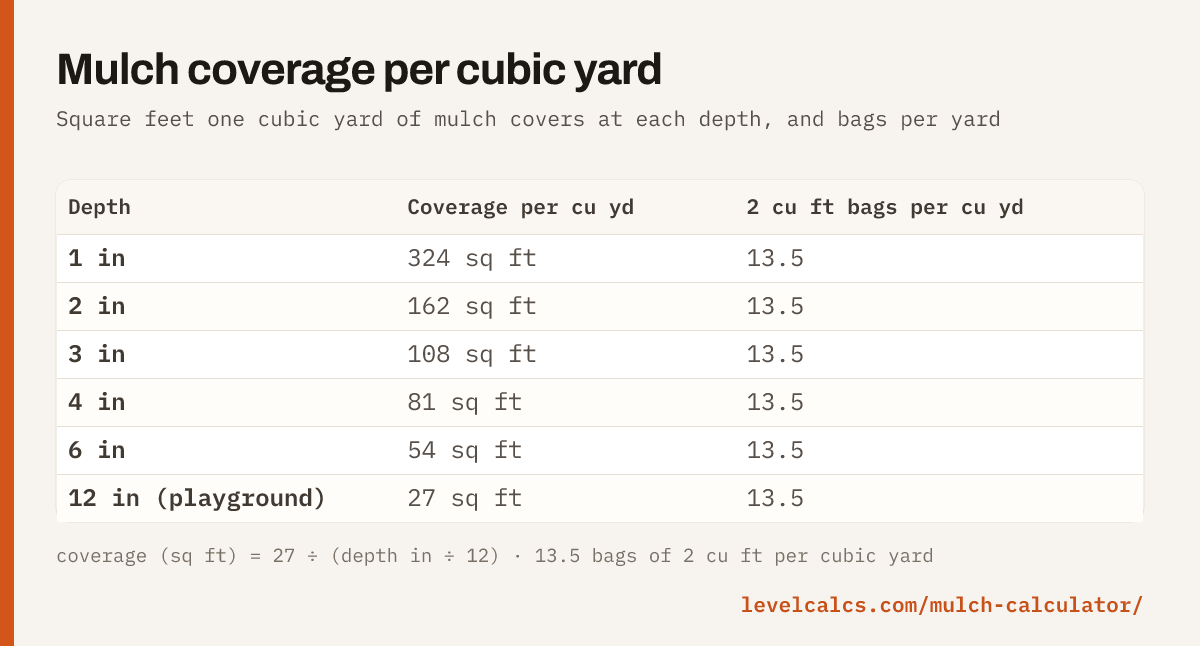
A cubic yard is 27 cubic feet. Spread 1 inch deep that’s 324 square feet, and every extra inch divides it again. At the 3 inches that suppresses weeds a yard covers 108 square feet, which is a bed about 10 by 11 ft.
The depth column is the one to get right before you order. Two inches is plenty for a top-up over last year’s mulch and for shallow-rooted shrubs. Three inches is the standard for a new bed. Four is for paths and for beds where you want the weeds gone for a season without any fabric.
| Depth | Coverage per cu yd | 2 cu ft bags per cu yd |
|---|---|---|
| 1 in | 324 sq ft | 13.5 |
| 2 in | 162 sq ft | 13.5 |
| 3 in | 108 sq ft | 13.5 |
| 4 in | 81 sq ft | 13.5 |
| 6 in | 54 sq ft | 13.5 |
| 12 in (playground) | 27 sq ft | 13.5 |
Ten yards of mulch covers 1,080 square feet at 3 inches, or 1,620 at 2 inches. That’s most of the beds on a quarter-acre lot, and it arrives as a pile about 15 ft across and 4 to 5 ft high, so clear the spot first.
How much area does a bag of mulch cover
Bags are sold by volume, and 2 cubic feet is the standard size at the big-box stores. A 2 cubic foot bag covers 12 square feet at 2 inches, 8 square feet at 3 inches and 6 at 4 inches. The 1.5 and 3 cubic foot bags scale from there.
So a 4 by 8 ft bed at 3 inches is 32 square feet, which is four 2 cubic foot bags. A 10 by 10 bed is 100 square feet and 13 bags, and a 20 by 10 is 25. Round up, because the last bag always goes further than you expect at the edges.
Coverage per single bag at the three common bag sizes.
| Bag size | At 2 in deep | At 3 in deep | At 4 in deep |
|---|---|---|---|
| 1.5 cu ft bag | 9 sq ft | 6 sq ft | 4.5 sq ft |
| 2 cu ft bag | 12 sq ft | 8 sq ft | 6 sq ft |
| 3 cu ft bag | 18 sq ft | 12 sq ft | 9 sq ft |
Watch the bag label rather than the shelf tag. The Mulch and Soil Council standard requires the volume on the bag, and some bags sold alongside the 2 cubic foot ones are 1.5 cubic feet. Eighteen of those make a yard, not thirteen and a half.
Bags to cubic yards
Multiply the bag count by the bag size in cubic feet, then divide by 27. Forty 2 cubic foot bags is 80 cubic feet, which is 2.96 cubic yards, so forty bags is three yards for ordering purposes. Thirteen and a half 2 cubic foot bags make exactly one yard, and nine 3 cubic foot bags do the same.
This is the conversion to run before you decide between bags and bulk. Once the bag count passes about forty, you’re at three yards, and that’s where a bulk delivery starts to cost less than the same mulch in bags.
| Bags | 1.5 cu ft bags | 2 cu ft bags | 3 cu ft bags |
|---|---|---|---|
| 10 | 0.56 cu yd | 0.74 cu yd | 1.11 cu yd |
| 20 | 1.11 cu yd | 1.48 cu yd | 2.22 cu yd |
| 27 | 1.50 cu yd | 2.00 cu yd | 3.00 cu yd |
| 30 | 1.67 cu yd | 2.22 cu yd | 3.33 cu yd |
| 40 | 2.22 cu yd | 2.96 cu yd | 4.44 cu yd |
| 50 | 2.78 cu yd | 3.70 cu yd | 5.56 cu yd |
| 54 | 3.00 cu yd | 4.00 cu yd | 6.00 cu yd |
| 100 | 5.56 cu yd | 7.41 cu yd | 11.11 cu yd |
Square feet to cubic yards
Area in square feet times depth in inches, divided by 324, gives cubic yards. A 500 square foot set of beds at 3 inches is 500 × 3 ÷ 324, which is 4.63 cubic yards. Order five, because a yard sells in whole and half yards and a little extra settles in by the second week anyway.
Measure the beds as rectangles and circles and add them up. A circular bed is 3.14 times the radius squared, so a 10 ft circle around a tree is 78.5 square feet, not 100.
| Area | At 2 in | At 3 in | At 4 in |
|---|---|---|---|
| 100 sq ft | 0.62 cu yd | 0.93 cu yd | 1.23 cu yd |
| 200 sq ft | 1.23 cu yd | 1.85 cu yd | 2.47 cu yd |
| 300 sq ft | 1.85 cu yd | 2.78 cu yd | 3.70 cu yd |
| 500 sq ft | 3.09 cu yd | 4.63 cu yd | 6.17 cu yd |
| 750 sq ft | 4.63 cu yd | 6.94 cu yd | 9.26 cu yd |
| 1,000 sq ft | 6.17 cu yd | 9.26 cu yd | 12.35 cu yd |
| 2,000 sq ft | 12.35 cu yd | 18.52 cu yd | 24.69 cu yd |
The common bed sizes, done the same way, are in the next table with the bag count alongside.
Mulch for common bed sizes
The same sum at 3 inches for the beds people have, with the 2 cubic foot bag count the calculator would give. Past about three yards the bag count gets silly, and that’s the point at which to ring a landscape yard for a bulk price.
Bags are 2 cu ft, rounded up (the size big-box stores sell most).
| Bed size | Area | Cubic yards | 2 cu ft bags |
|---|---|---|---|
| 4 × 8 ft | 32 sq ft | 0.30 cu yd | 4 |
| 12 × 8 ft | 96 sq ft | 0.89 cu yd | 12 |
| 10 × 10 ft | 100 sq ft | 0.93 cu yd | 13 |
| 20 × 10 ft | 200 sq ft | 1.85 cu yd | 25 |
| 500 sq ft of beds | 500 sq ft | 4.63 cu yd | 63 |
| 1,000 sq ft of beds | 1,000 sq ft | 9.26 cu yd | 125 |
What a yard of mulch weighs
A cubic yard of dry wood mulch weighs 400 to 800 lb depending on the species. Pine bark nuggets sit nearer 450 lb, shredded hardwood 500 to 700. That makes mulch about the one landscape material a half-ton pickup can take two or three yards of, where it would run out of payload after one yard of topsoil or gravel.
Rain changes it. Soaked hardwood can pass 1,000 lb a yard, so a pile that sat out through a wet week is a different load from the same pile in August. If you’re collecting rather than taking delivery, go after a dry spell.
Sources
Coverage figures are the mulch calculator’s own arithmetic from 27 cubic feet per cubic yard. Bag labelling follows the Mulch and Soil Council’s product standards.
Run your numbers
Bed length, width and depth in, cubic yards and bags out, with the cost at your bag price. Then the topsoil calculator if the bed needs building up first.
Common questions
How many square feet does a yard of mulch cover?
108 square feet at 3 inches deep. At 2 inches it’s 162 square feet and at 4 inches it’s 81. A yard is 27 cubic feet, so divide 324 by the depth in inches.
How much does a bag of mulch cover?
A 2 cubic foot bag covers 8 square feet at 3 inches, 12 at 2 inches and 6 at 4 inches. A 3 cubic foot bag covers half as much again, and a 1.5 cubic foot bag three-quarters of that.
How many bags of mulch are in a yard?
13.5 bags of 2 cubic feet, 9 bags of 3 cubic feet or 18 bags of 1.5 cubic feet. A cubic yard is 27 cubic feet, so divide 27 by the bag size.
40 bags of mulch is how many yards?
About 3 cubic yards if they’re 2 cubic foot bags (80 cubic feet ÷ 27 = 2.96). Forty 3 cubic foot bags is 4.4 yards, and forty 1.5 cubic foot bags is 2.2.
How much does 10 yards of mulch cover?
1,080 square feet at 3 inches, 1,620 square feet at 2 inches or 810 square feet at 4 inches. Ten yards is 270 cubic feet, the same as 135 bags of 2 cubic feet.
What is the standard mulch bag size?
2 cubic feet is the common size at big-box stores. Bagged bark and some premium mulches come in 1.5 and 3 cubic foot bags, so check the volume printed on the bag before you count.
How do I convert square feet to yards of mulch?
Square feet × depth in inches ÷ 324. A 300 square foot bed at 3 inches is 300 × 3 ÷ 324, or 2.78 cubic yards. Order three.
How deep should mulch be?
Two to three inches for most beds. Three inches blocks light well enough to stop most weeds. Keep it to 2 inches over shallow-rooted shrubs and never pile it against trunks or stems.